911FINDER
Porsche 996 Turbo

Home/Price Trends/996 Turbo & Turbo S

The first water-cooled Turbo · 2000-2006

Porsche 996 Turbo & Turbo S Price Development

From falling values to an upward trend: list prices, market analysis, investment potential and a forecast to 2030 for the Turbo with the Mezger engine, supplemented for the June 2026 update by 417 documented sales from the MarqueScope SOLD archive.

The models Findings Investment potential Buying tips Forecast 2030 Conclusion
Overview and introduction

A technological turning point

The Porsche 996 Turbo holds a special position in the history of the legendary 911 Turbo. As the first water-cooled Turbo in the line, it marked a significant technological turning point in 1999/2000. With its engine, developed by Hans Mezger and derived from the Porsche 911 GT1, it not only set the standard on performance but also established new standards for everyday usability and reliability.

The Turbo S version that followed later, with the factory power enhancement (WLS) as standard, raised the exclusivity and the prestige of the car further still. Between 2000 and 2006, a total of 22,062 examples of the 996 Turbo Coupé and 3,534 cabriolets were built. Of the more exclusive Turbo S, only 600 Coupés and 963 cabrioletswere made, which makes them particularly sought-after collector's cars.

In this analysis we examine the price development of the Porsche 996 Turbo and Turbo S from launch to today, and look ahead to their value development to 2030.

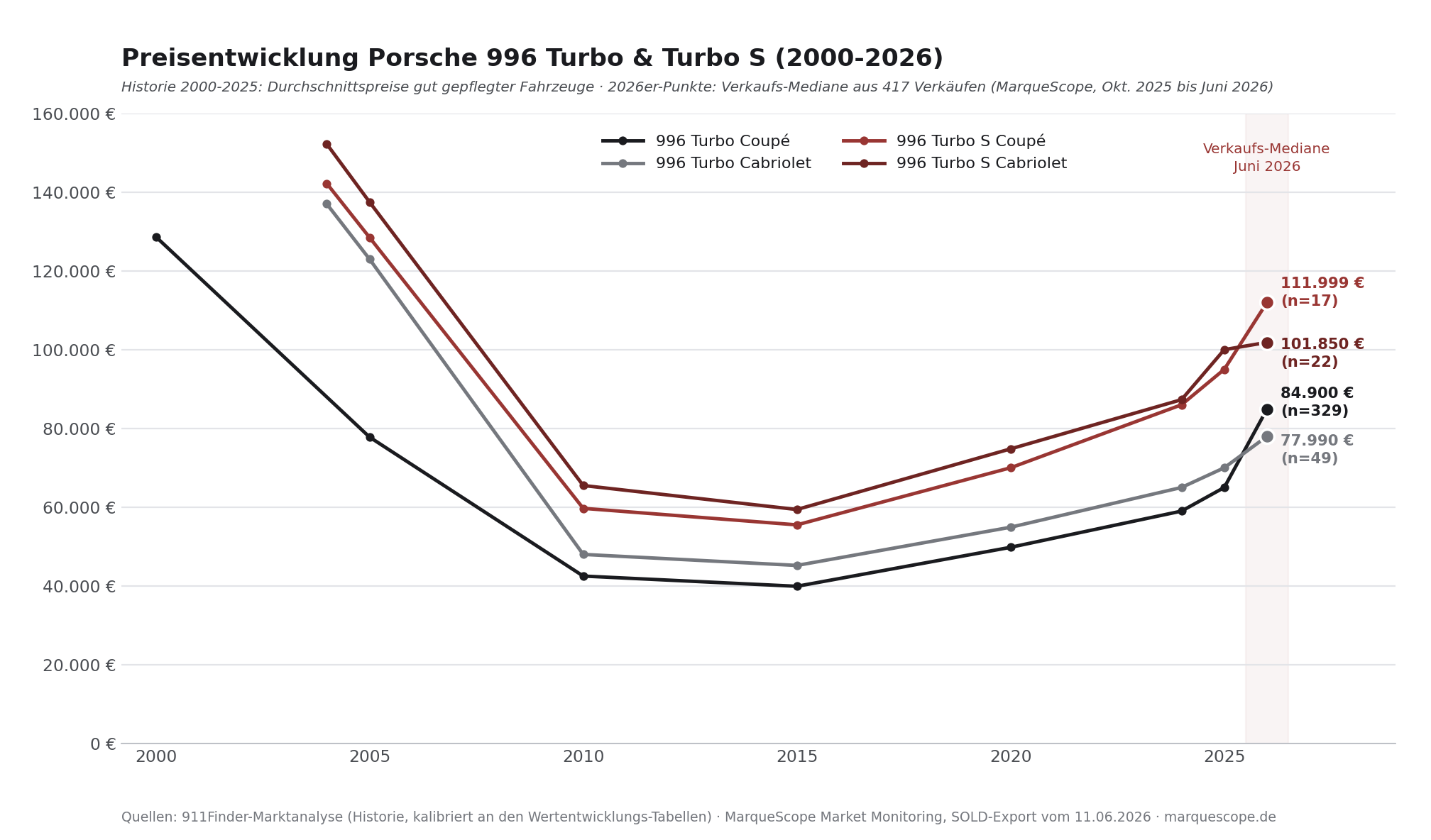
For the June 2026 update, the historical curves were supplemented by 417 documented sales from the MarqueScope SOLD archive (October 2025 to June 2026, with records lacking a sale price and prices below €15,000 removed). Figures up to 2025 are average prices, the 2026 points median sale prices; this change of method is shown in every table and chart.

Historical price development of the Porsche 996 Turbo and Turbo S, 2000 to 2026: four variants with median sale prices for June 2026
Historical price development 2000-2025 (average prices), with median sale prices for June 2026 by model
417

documented sales in the MarqueScope archive (as at June 2026)

€84.9k

Median sale price, 996 Turbo Coupé (June 2026)

+12.0 €k

The manual premium over the Tiptronic on the Turbo Coupé

€112.0k

Median sale price, 996 Turbo S Coupé, the highest in the series

Model specifications and distinguishing features

The Turbo and Turbo S in profile

911 (996) Turbo

2000-2006

  • A 3.6-litre water-cooled twin-turbo flat six (the Mezger engine) with 309 kW (420 PS)
  • Torque: 560 Nm from 2,700-4,600 rpm
  • 0-100 km/h in 4.2 s, top speed 305 km/h
  • An especially durable engine derived from the 911 GT1, without the typical problems of the water-cooled flat six in the standard Carrera models
  • From the end of 2001, optionally with the factory power enhancement (X50): 331 kW (450 PS) and 620 Nm of torque
  • List price (2000): around €128,676 (Germany), around $111,000 (USA)
  • Production: 22,062 Coupés, 3,534 cabriolets

911 (996) Turbo S

2004-2006 · very limited

  • A 3.6-litre water-cooled twin-turbo flat six (the Mezger engine) with 331 kW (450 PS)
  • Torque: 620 Nm
  • 0-100 km/h in 4.2 s, top speed 307 km/h
  • With the previously optional factory power enhancement (X50), PCCB (Porsche Ceramic Composite Brake) and numerous further extras as standard
  • List price (2004): around €142,200 for the Coupé, around €152,224 for the cabriolet
  • Production: 600 Coupés, 963 cabriolets
Price Trends

Key findings from the analysis

1. Falling values and stabilisation +

After the steep initial fall in value between 2000 and 2010, prices reached their low point between 2010 and 2015. Since 2015 a continuous rise in value has been visible.

2. A robust rise in value since 2015 +

Unlike the standard Carrera models, the Turbo variants reached their low point earlier and have risen continuously in value since 2015.

3. The rarity factor +

The Turbo S cars, with their considerably smaller production numbers (600 Coupés, 963 cabriolets), show better value development than the regular Turbo versions.

4. Body styles +

Looked at historically, the cabriolet sat at a slightly higher price level than the Coupé on both variants. The sales data from June 2026 draw a different picture: on the Turbo (€84,900 against €77,990) and on the Turbo S (€111,999 against €101,850) alike, Coupés most recently traded above the cabriolets. On the Turbo S this fits the production numbers, because at 600 cars the Coupé is the rarer one (cabriolet: 963).

5. The technical difference +

The Mezger engine fitted to the Turbo is regarded as extremely robust and undemanding, which helps it hold its value in the long term, because the known problems of the standard engine (IMS failure) do not occur here.

Documented sales: MarqueScope market data (as at June 2026)

417 documented Turbo sales from the MarqueScope SOLD archive (October 2025 to June 2026, with records lacking a sale price and prices below €15,000 removed). Unlike the Carrera models, the 996 Turbo had no facelift split into 996.1 and 996.2; the corresponding platform labels are therefore merged into four rows by body style and S variant, and all medians were calculated from the raw data. Prices correspond to the last recorded asking price of the car sold.

ModelSalesMedianRangeMedian kmDays on market
996 Turbo Coupé329€84,900€38,500 - €188,00075,486-
996 Turbo cabriolet49€77,990€52,102 - €169,00094,90428 days
996 Turbo S Coupé17€111,999€38,000 - €199,99974,00038 days
996 Turbo S cabriolet22€101,850€69,996 - €216,65251,60542 days

On the merge: the labels "996.1 Turbo" and "996.2 Turbo" are recording artefacts of the source marketplaces, not a facelift distinction. The fact that Coupés labelled "996.1 Turbo" sit lower (a median of €69,996 across 27 sales against €84,900 across 302) is therefore to be read as a platform artefact, not as a premium for a facelift. Time on the market: in the largest platform cell, the time on the market is systematically recorded as 0 days (153 of the 329 Coupé records); the median time on the market for the Turbo Coupé is therefore not reliable and is not shown. The extremes of the range are explained by mileage and condition: the cheapest sales (€38,000 and €38,500) were cars with more than 120,000 km, while the top sale (€216,652, a Turbo S cabriolet) showed 27,909 km. Transmissions are assigned from the documented specification; cars with no evidence of a manual are counted in the Tiptronic group.

For dealers & professionals: This table is an extract. The full MarqueScope dashboard gives you active listings, the complete SOLD archive, days on market, price deltas and options scores for 8 premium marques, turning 3 hours of research into 5 minutes. Discover MarqueScope →
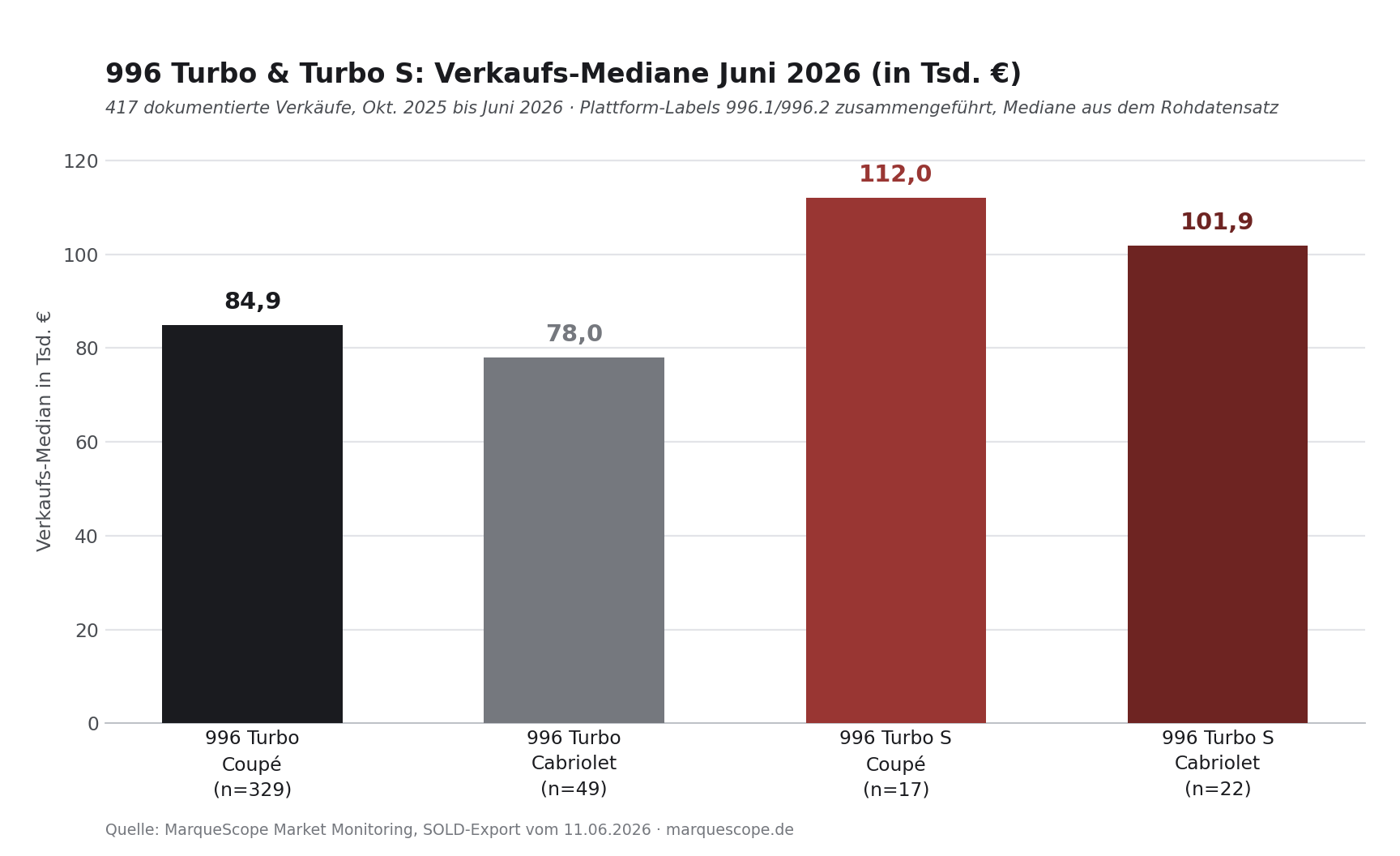
996 Turbo and Turbo S median sale prices by variant, June 2026, a bar chart in thousands of euros
Median sale prices by variant (June 2026), figures in thousands of euros
What the June 2026 sales data shows +
  • The manual premium is the key figure of this update: Turbo Coupés with a manual gearbox achieved a median of €84,900 (200 sales), Tiptronic cars €72,900 (129 sales), a gap of €12,000. On the cabriolet the effect is small (€79,800 against €77,626); on the Turbo S variants the manual cells, with 4 and 2 sales, are too thin for reliable statements
  • The market has overtaken the 2025 forecast: the Coupé median of €84,900 is above the forecast value for 2027 (€72,000) and practically at the 2030 level (€85,000); at €111,999, the Turbo S Coupé likewise already exceeds its 2027 mark (€105,000)
  • The Coupé beats the cabriolet, against the previous order: 996 Turbo Coupé €84,900 against €77,990 (cabriolet), Turbo S Coupé €111,999 against €101,850 (Turbo S cabriolet). On the Turbo S this fits the numbers, because at 600 cars the Coupé is rarer than the cabriolet (963)
  • Mileage as a driver of value: the Turbo S cabriolet shows a median mileage of 51,605 km, low in the way collector cars are, and the most expensive sale in the archive is a Turbo S cabriolet at €216,652 with 27,909 km
  • The factory power enhancement (X50/WLS): explicitly documented as fitted on only 6 of the 417 sales, too few for a reliable statement about a premium
  • Time on the market: a median of 28 days for the cabriolet, 38 for the Turbo S Coupé and 42 for the Turbo S cabriolet; for the Turbo Coupé the figure is not reliable because of the platform artefact declared above (the 0-day entries)
Source: MarqueScope market monitoring, export of 11 June 2026. More at marquescope.de
Growth in value at a glance

Investment potential

The Porsche 996 Turbo, and the Turbo S in particular, offer interesting investment potential for several reasons:

1. The Mezger engine: the Mezger engine used in the 996 Turbo is a technical particularity and is regarded as extremely reliable. That raises the appeal of the 996 Turbo considerably compared with the standard Carrera models.

2. Historical significance: as the first water-cooled 911 Turbo, the 996 Turbo marks an important milestone in the history of the line.

3. Performance figures: with 420 PS, or 450 PS in the Turbo S, the 996 Turbo offers impressive performance even by today's standards and counts as one of the best performance bargains on the used Porsche market.

4. Limited numbers: the Turbo S in particular, with only 1,563 cars built (600 Coupés, 963 cabriolets), has good prospects of above-average growth in value thanks to its rarity.

5. Compared with its successor: compared with the 997 Turbo, the 996 Turbo is still considerably cheaper although barely inferior technically, which points to further potential.

Value development at a glance

ModelLoss in value 2000-2010Loss in value 2000-2015Growth in value 2015-2024Value development since new
996 Turbo Coupé-67%-69%+48%-54%
996 Turbo cabriolet-65%-67%+44%-53%
996 Turbo S Coupé-58%-61%+55%-40%
996 Turbo S cabriolet-57%-61%+47%-42%

Percentages relate to the respective list price; for the variants introduced only in 2004 (Turbo cabriolet, Turbo S), the columns relate to the period from launch. The analysis is as at 2024/2025, based on average prices of well-kept cars. Depending on the model, the median sale prices from June 2026 are already above the 2024 levels shown here.

Which model for which kind of buyer?

  • For newcomers: a well-kept early 996 Turbo with a manual gearbox is currently one of the best ways into the world of high-performance Porsches, with impressive value for money
  • For investors: the 996 Turbo S in a limited colour and with low mileage offers the best potential for growth in value thanks to its small numbers
  • For enthusiasts: a 996 Turbo with the X50 factory power enhancement and a manual gearbox combines impressive performance with the prospect of growth in value
  • For collectors: very rare colour combinations (Speed Yellow or Guards Red, for example) or special models are particularly in demand among collectors and correspondingly more stable in value

Production numbers at a glance

  • 996 Turbo Coupé: 22,062 cars
  • 996 Turbo cabriolet: 3,534 cars
  • 996 Turbo S Coupé: only 600 cars
  • 996 Turbo S cabriolet: only 963 cars

Buying recommendation by budget

BudgetRecommendedReasoning
up to €75,000996 Turbo Coupé with TiptronicThe cheapest way into the Mezger world: a median sale price of €72,900 (June 2026) on a technically identical basis
€75,000-€90,000996 Turbo Coupé with a manual gearbox, or the Turbo cabrioletThe manual is the sought-after configuration (median €84,900); the cabriolet (€77,990) offers open-top driving with the Mezger engine
€90,000-€110,000996 Turbo S cabrioletThe factory power enhancement and PCCB as standard, a median sale price of €101,850 at a low median mileage (51,605 km)
more than €110,000996 Turbo S CoupéAt 600 cars the rarest variant, a median sale price of €111,999, the highest in the series

Budget ranges aligned to the June 2026 median sale prices from the MarqueScope SOLD archive; depending on mileage, history and specification, considerable deviations are possible.
Specialist knowledge

What should prospective buyers look for?

1. Service history +

Complete documentation of all servicing is essential. Because of the high output, many 996 Turbos were used hard, so regular oil changes (ideally every 10,000 km) are particularly important.

2. Turbo coolant lines +

The epoxy joints of the turbo coolant lines can fail over time and lead to a massive loss of coolant. A check and, if needed, preventive replacement are advisable.

3. Gearbox +

On manual cars, listen for shifts free of crunching, particularly from first to second. That points to synchromesh that has been treated well.

4. Ceramic brakes (PCCB) +

If a car has the ceramic brakes (optional on the Turbo, standard on the Turbo S), their condition should be checked carefully. A replacement can quickly swallow a five-figure sum.

5. The factory power enhancement +

On cars said to have the X50 factory power enhancement, always check for the corresponding code on the sticker in the front luggage compartment. Tuning carried out later should be viewed with scepticism.

6. Tiptronic vs manual +

While the Tiptronic is regarded as the more robust, cars with a manual gearbox generally achieve higher prices thanks to their sportier character and have better potential for growth in value.

7. Condition of the body +

Watch for signs of accident damage. The complex all-wheel-drive system and the wider body make repairs to a 996 Turbo considerably more expensive than on the standard cars.

The 996 Turbo model bible

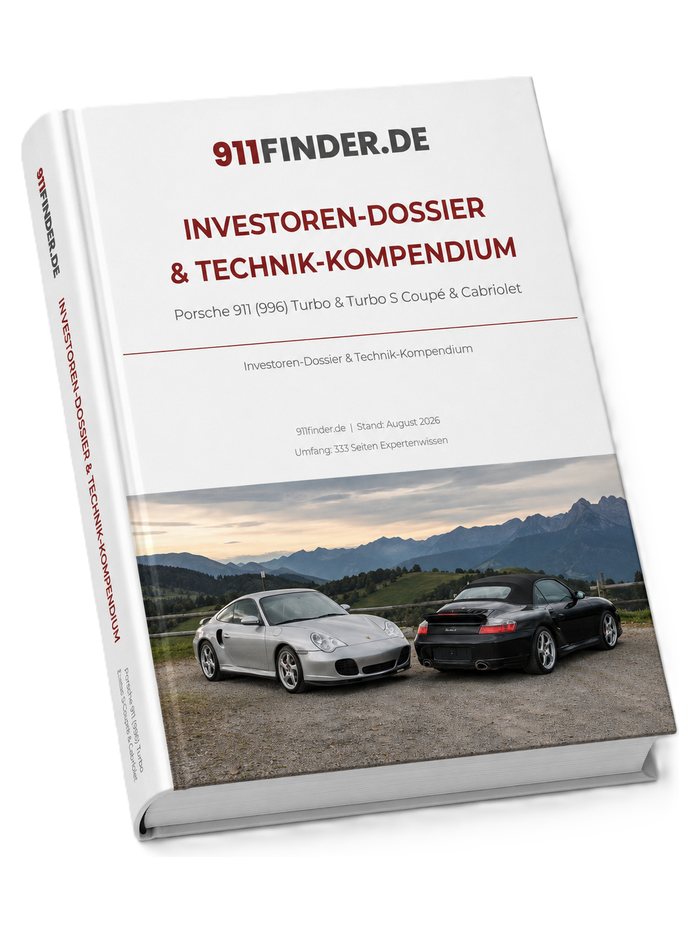
The complete knowledge: the Investor Dossier & Technical Compendium, in German

Detailed expert knowledge on the 996 Turbo and Turbo S: weak points, inspection checklists, production figures, value-enhancing options and price forecasts.

€97

incl. VAT

To the compendium (German)
Outlook

Forecast to 2030

Based on the market situation and the historical trends, the following forecast for value development to 2030 was produced in 2025. It is deliberately documented here unchanged, so that its accuracy can be checked against the actual sales data.

Price forecast to 2030 (as of 2025)

Model202520272030
996 Turbo Coupé€65,000€72,000€85,000
996 Turbo cabriolet€70,000€78,000€90,000
996 Turbo S Coupé€95,000€105,000€125,000
996 Turbo S cabriolet€100,000€110,000€130,000

Forecast produced in 2025 on the basis of average prices of well-kept cars; all figures rounded.

Reality check, June 2026: the market has overtaken the forecast. At €84,900, the median sale price of the 996 Turbo Coupé is already above the value forecast for 2027 (€72,000) and practically at the 2030 level (€85,000). At €111,999, the Turbo S Coupé likewise exceeds its 2027 mark (€105,000). The Turbo cabriolet (€77,990) practically reaches its 2027 value (€78,000) already in 2026; only the Turbo S cabriolet (€101,850) still sits between its 2025 and 2027 marks. In making the comparison, bear in mind that the change of method contributes alongside the dynamics of the market: the forecast was calculated on average prices, while the 2026 figures are median sale prices of documented sales.

The forecast is based on the following factors:

1. A continuation of the current trend +

The moderate to strong growth in value of recent years will probably continue, and the rarity of the Turbo S should lead to disproportionate development.

2. A special technical position +

As a technical jewel, the Mezger engine will be valued as a special feature as it grows older, much as air cooling is on older 911s today.

3. A change of generation among buyers +

A new generation of buyers who grew up with the 996 is now entering the stage of life in which they can afford one, which should increase demand.

4. Market segmentation +

Immaculately kept cars with low mileage will rise disproportionately, while high-mileage cars will gain in value more slowly.

5. The Porsche approach to its classics +

Porsche's support for its classics and the good supply of spare parts will help these cars survive in the long term and so support their appeal as collector's cars.

The balance

Conclusion

The Porsche 996 Turbo, and the Turbo S in particular, have an impressive journey behind them. After a clear initial fall in value in the first years of ownership, both models have now passed their low point and have shown a steady upward development for several years.

The Turbo S in particular, with its small numbers and its maximum specification as standard, has the potential to become a sought-after classic in the coming years. But the standard 996 Turbo, with its robust Mezger engine and performance that still impresses, offers excellent value for money for enthusiasts too.

The combination of technical maturity, historical significance as the first water-cooled 911 Turbo and the relative affordability that still applies compared with older and newer Turbo generations makes the 996 Turbo an attractive investment, with the added bonus of an outstanding driving experience.

The 911Finder assessment

For buyers looking for a high-performance sports car they can use every day and that has good investment potential, the Porsche 996 Turbo is currently one of the best options in the premium sports car segment. That applies in particular to well-kept cars with a transparent history, which will probably see stable to above-average value development in the coming years. As with every collector's car, though: the pleasure of driving should always come first, and then the growth in value usually follows by itself.

The data used in this analysis are based on market observation, sales statistics and expert assessment from various sources. The sales data from June 2026 marked as such come from the MarqueScope SOLD archive (October 2025 to June 2026, marquescope.de). All other prices are average figures and can vary considerably by individual specification, condition and mileage.

The next step

Buy this 911 with confidence, with 911Finder.

Do you already own a 911 from this model series? The Vehicle Documentation & Market Valuation puts the history, the paperwork and the market value of your car in order (€249 incl. VAT). Still looking? Then the right route is the Sourcing Enquire and name the model: Request a Digital Audit for a car from this model series.