Twenty-five years of values for the Mezger-engined GT models: list prices when new, the low point, the recovery, the current correction and a forecast to 2030. Supplemented for the June 2026 update by 136 documented sales from the MarqueScope SOLD archive.
The GT models of the Porsche 996 are the sharpest expression of the first water-cooled 911 generation. At a time when purists often took a dim view of the regular 996 over the switch to water cooling and the styling it shared with the Boxster, the GT variants stood for uncompromising sporting intent and genuine racing DNA. Built in comparatively small numbers, they have become sought-after collector cars over the years.
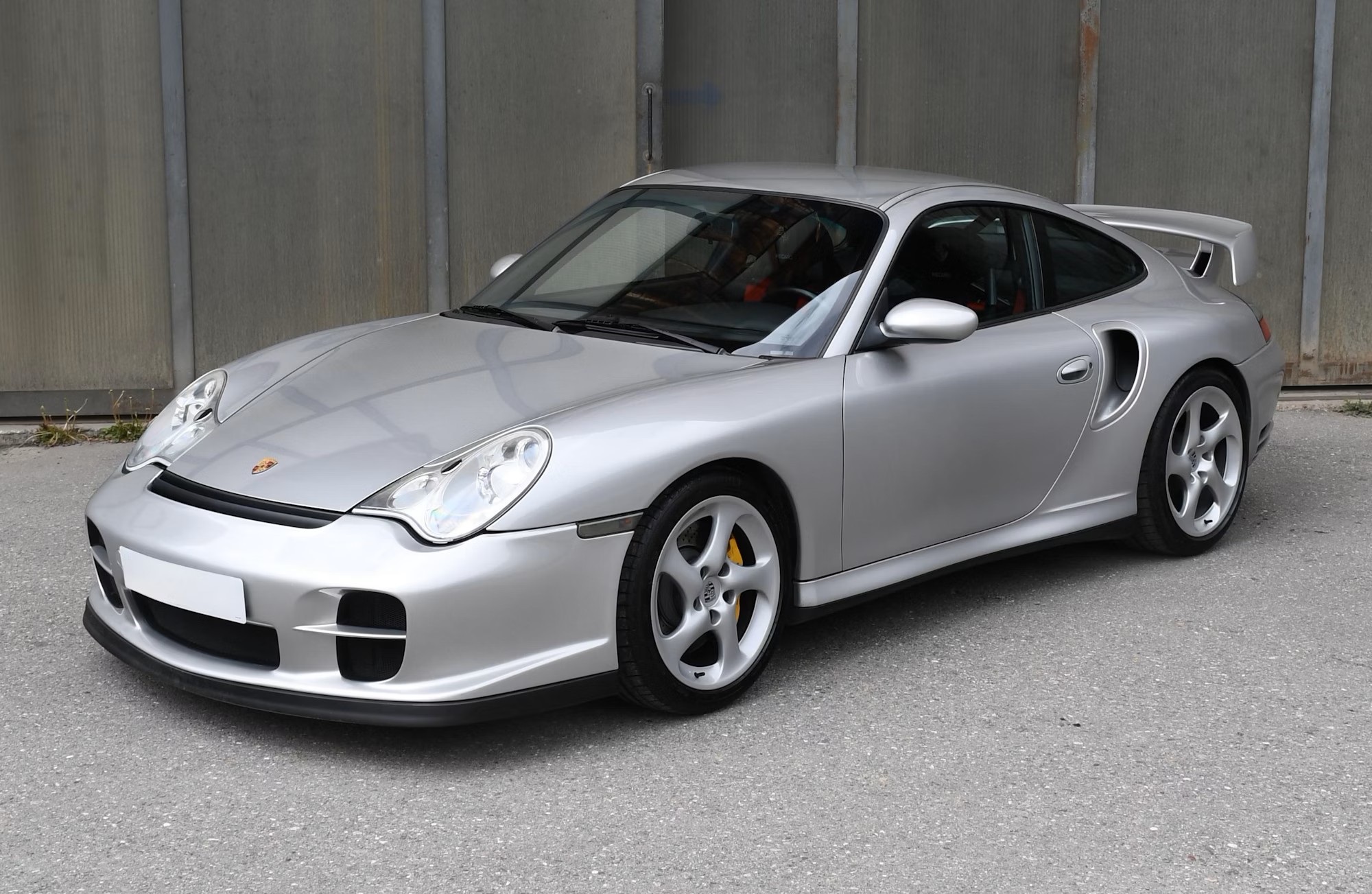
This analysis examines the historical price trends of the three most important GT models of the Porsche 996: the Porsche 996 GT3 (MK1: 1999-2001 with 360 PS, and MK2: 2003-2005 with 381 PS), the Porsche 996 GT3 RS (MK2: 2003-2004 with 381 PS and a range of weight-saving measures), and the Porsche 996 GT2 (MK1: 2001-2003 with 462 PS, and MK2: 2004-2005 with 483 PS).
By looking at list prices when new, at how values have moved and at current trends, this analysis offers useful insight for collectors, enthusiasts and investors interested in these exceptional cars.
For the June 2026 update, the historical curves were supplemented by 136 documented sales from the MarqueScope SOLD archive (October 2025 to June 2026; 122 cars after de-duplication). Figures up to 2025 are average prices, the 2026 points median sale prices; this change of method is flagged in every table and chart. The GT3 RS cell has been cleaned, and the sales archive treats the GT2 as a single model range; every intervention is declared in the market-data section.
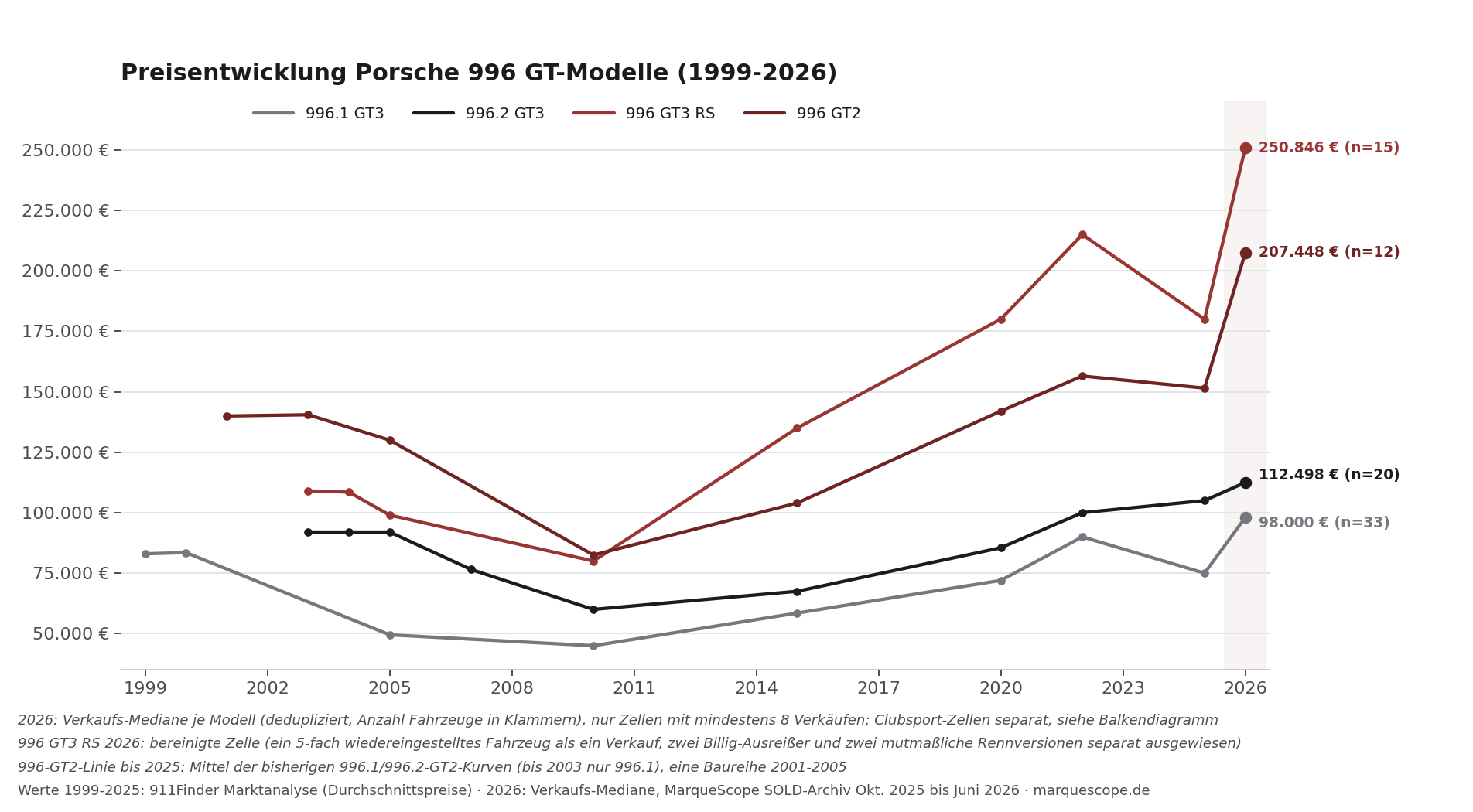
Price trends 1999-2025 (average prices) with June 2026 median sale prices per model; to 2025 the GT2 line runs as the mean of the previous 996.1 and 996.2 curves
136
Documented GT sales in the MarqueScope archive (June 2026)
€251k
Cleaned median sale price, 996 GT3 RS
+109 %
RS median sale price against the 2003 list price
2010
A shared low point
Model specifications and distinguishing features
From the GT3 to the GT2
996 GT3 MK1
1999-2001 · the first GT3 of all
3.6-litre water-cooled flat-six (the Mezger engine) with 265 kW (360 PS), 370 Nm
0-100 km/h in 4.8 s, top speed 302 km/h (the first production 911 past 300 km/h)
An engine derived from the 911 GT1 racing car, and the first road-going Porsche under eight minutes on the Nordschleife (Walter Röhrl: 7:56)
List price when new (1999): DM 179,500 (about €91,800)
Production: 1,868 cars
The Clubsport package (roughly 20 per cent of all cars) with a roll cage, bucket seats and carbon-fibre lids
996 GT3 MK2
2003-2005 · the refined evolution
3.6-litre water-cooled flat-six (the Mezger engine) with 280 kW (381 PS), 385 Nm
0-100 km/h in 4.5 s, top speed 306 km/h
A revised, more conventional rear wing and better aerodynamics
List price when new (2003): roughly €103,000
Production: 2,313 cars
996 GT3 RS
2003-2004 · the lightweight outperformer
3.6-litre water-cooled flat-six (the Mezger engine) with 280 kW (381 PS), 385 Nm
0-100 km/h in 4.4 s, top speed 306 km/h
The lightweight version of the GT3: polycarbonate rear screen, carbon-fibre bonnet, wide body, the characteristic RS graphics, dampers 10-15 per cent stiffer, 1,360 kg
List price when new (2003): roughly €120,000
Production: 682 cars
Never offered in the United States
996 GT2 MK1
2001-2003 · the analogue twin-turbo
3.6-litre twin-turbocharged water-cooled flat-six (the Mezger engine) with 340 kW (462 PS), 620 Nm
0-100 km/h in 4.1 s, top speed 315 km/h
No all-wheel drive, the first Porsche with xenon headlights as standard, and no electronic driver aids (no Porsche Stability Management)
List price when new (2001): DM 339,000 (about €173,328)
Production: 963 cars
996 GT2 MK2
2004-2005 · the extreme exotic
3.6-litre twin-turbocharged water-cooled flat-six (the Mezger engine) with 355 kW (483 PS), 640 Nm
0-100 km/h in 3.9 s, top speed 319 km/h
Lighter again than the MK1, with better aerodynamics
List price when new (2004): roughly €185,000
Production: 1,287 GT2s in all, of which 963 up to April 2003 (the MK1) and 324 from model years 2003-2005 (Streather); taken narrowly, the literature counts 95 MK2 cars from April 2003 (75 left-hand drive, 20 right-hand drive)
The key findings at a glance
How prices have moved, in brief
A shared low in 2010: every model bottomed out around 2010
A two-stage recovery: moderate from 2010 to 2015, then stronger appreciation from 2015 to 2023
The current correction: three of the five have been correcting downwards since 2023; only the 996.2 GT3 has edged up, and the 996.2 GT2 has held its level
Strong differentiation: they moved much alike at first, and their prices now diverge sharply
A surprising leader: the 996 GT3 RS, with by far the strongest appreciation
June 2026 sales data: the documented sales bear out the RS story, at a cleaned median sale price of €250,846 across 15 cars
1999-2026 in detail
Price trends in detail
Twenty-five years of values across the five GT variants: from the list price when new, through the low around 2010 and the market as it stood in 2025, to the documented sales of June 2026.
Porsche 996.1 GT3 (1999-2001) +
The facts: Engine: 3.6-litre water-cooled flat-six (the Mezger engine) with 265 kW (360 PS), torque 370 Nm. What sets it apart: the first GT3 of all, with an engine derived from the 911 GT1 racing car. Production: 1,868 cars.
Starting price around 2000: roughly €85,000 (list price when new: €91,800)
Low around 2010: roughly €45,000 (-47% against the starting value)
Peak in 2022/23: roughly €90,000 (+100% against the low)
Current value in 2025: roughly €75,000 (a correction of 16% from the peak)
June 2026 sales data: a €98,000 median across 33 cars (de-duplicated), a range of €66,000 to €215,000 and a median mileage of 72,100 km; the Clubsport cell achieves €109,106 (15 sales)
What stands out: Of all the GT variants considered here, the 996.1 GT3 is the only one that has still not regained its list price when new. At roughly €75,000 today it sits around 18 per cent below it.
Its path is a classic V: heavy depreciation from 2000 to 2010, then a slow but steady recovery since. The correction since 2023 has given back part of the gains.
Porsche 996.2 GT3 (2003-2005) +
The facts: Engine: 3.6-litre water-cooled flat-six (the Mezger engine) with 280 kW (381 PS), torque 385 Nm. What sets it apart: a revised, more conventional rear wing and better aerodynamics. Production: 2,313 cars.
Entry price in 2003/2004: roughly €90,000 (list price when new: €103,000)
Low around 2010: roughly €60,000 (-33% against the starting value)
Peak in 2022/23: roughly €100,000 (+67% against the low)
Current value in 2025: roughly €105,000 (+5% since 2023)
June 2026 sales data: a €112,498 median across 20 cars (de-duplicated), with the Clubsport cell at €119,000 (9 sales); both sit above the 2025 average
What stands out: Since 2023 the 996.2 GT3 has steadied and even recovered slightly, against the general trend among the others. It has passed its original entry price of roughly €90,000 by around 17 per cent, which puts it just 2 per cent above its list price when new (though still below it once adjusted for inflation).
Its path has been more moderate and less volatile than the 996.1 GT3’s, with a less drastic fall and a steadier recovery. It is the only one of the five currently trending upwards since 2023.
Porsche 996.2 GT3 RS (2003-2004) +
The facts: Engine: 3.6-litre water-cooled flat-six (the Mezger engine) with 280 kW (381 PS), torque 385 Nm. What sets it apart: the lightweight version, with a polycarbonate rear screen, a carbon-fibre bonnet, the wide body and the characteristic RS graphics. Production: 682 cars.
Entry price in 2003/2004: roughly €110,000 (list price when new: €120,000)
Low around 2010: roughly €80,000 (-27% against the starting value)
Peak in 2023: roughly €215,000 (+169% against the low)
Current value in 2025: roughly €180,000 (a correction of 16% from the peak)
June 2026 sales data: a cleaned median sale price of €250,846 across 15 cars, median mileage 30,100 km; that is roughly 109 per cent above the list price when new (the cleaning is set out in the market-data section)
What stands out: The 996.2 GT3 RS shows by far the strongest appreciation of any car considered here. At roughly €180,000 today it sits 50 per cent above its list price when new. It suffered the smallest initial fall and made the strongest recovery.
The rise is pronounced from 2015 onwards, and steeper still between 2020 and 2023. Even after the current correction it sits considerably above the others and has proved exceptionally stable in value.
Porsche 996.1 GT2 (2001-2003) +
The facts: Engine: 3.6-litre twin-turbocharged water-cooled flat-six (the Mezger engine) with 340 kW (462 PS), torque 620 Nm. What sets it apart: no all-wheel drive and no electronic driver aids (no Porsche Stability Management). Production: 963 cars.
Entry price in 2000/2001: roughly €140,000 (list price when new: €173,328)
Low around 2010: roughly €80,000 (-43% against the starting value)
Peak in 2022/2023: roughly €155,000 (+94% against the low)
Current value in 2025: roughly €145,000 (a correction of 6% from the peak)
June 2026 sales data: the sales archive treats the GT2 as a single model range (median €207,448, 12 cars); the three sales listed as 996.1 fell between €144,900 and €179,900
What stands out: After a heavy initial fall the 996.1 GT2 has recovered impressively. At €145,000 its current value is only just above its entry price of €140,000, and well below its list price when new of €173,328.
For all its exclusivity, its power and the analogue experience of driving it without electronic aids, it has not appreciated as expected. The relatively high production run of 963 cars and its reputation as a demanding car to drive may both play a part.
Porsche 996.2 GT2 (2004-2005) +
The facts: Engine: 3.6-litre twin-turbocharged water-cooled flat-six (the Mezger engine) with 355 kW (483 PS), torque 640 Nm. What sets it apart: lighter again than the MK1, with better aerodynamics. Production: 324 cars from model years 2003-2005 on Streather’s count; taken narrowly, 95 MK2 cars from April 2003.
Entry price in 2005: roughly €150,000 (list price when new: €185,000)
Low around 2010: roughly €85,000 (-43% against the starting value)
Peak in 2023: roughly €158,000 (+86% against the low)
Current value in 2025: roughly €158,000 (steady since 2023)
June 2026 sales data: the 996 GT2 as a whole at a €207,448 median (12 cars, both series combined); the top figures of €430,399 and €499,996 came from two low-mileage cars offered in the United States
What stands out: Along with the 996.2 GT3, the 996.2 GT2 is the only car here that has seen no significant fall in recent years. Depending on how you count, at 324 cars from model years 2003-2005, or 95 MK2 cars taken narrowly, it is the rarest of those considered. Despite that limited run, its appreciation falls well short of the GT3 RS.
At €158,000 today it sits roughly 5 per cent above its entry price but still below its list price when new of €185,000. Its stability over the past two years may come down to how rare it is.
How all five models compare
Model
List price when new
Low around 2010
Peak 2022/23
Value in 2025
996.1 GT3 (1999-2001)
approx. €91,800
approx. €45,000
approx. €90,000
approx. €75,000
996.2 GT3 (2003-2005)
approx. €103,000
approx. €60,000
approx. €100,000
approx. €105,000
996.2 GT3 RS (2003-2004)
approx. €120,000
approx. €80,000
approx. €215,000
approx. €180,000
996.1 GT2 (2001-2003)
approx. €173,328
approx. €80,000
approx. €155,000
approx. €145,000
996.2 GT2 (2004-2005)
approx. €185,000
approx. €85,000
approx. €158,000
approx. €158,000
All figures are averages (as at 2025) and can vary considerably depending on specification, condition and mileage.
Documented sales: MarqueScope market data (as at June 2026)
136 documented 996 GT sales from the MarqueScope SOLD archive (October 2025 to June 2026), 122 cars after de-duplication. The table shows the road cars; racing versions are listed separately below. Prices are the last recorded asking price of the car that sold. No comparison of transmissions is made, deliberately: every 996 GT left the factory with a manual gearbox only, and all 136 listings are manuals; differing transmission flags in the raw export are recording noise.
Model
Sales
Median
Range
Median km
Days on market
996.1 GT3
33
€98,000
€66,000 - €215,000
72,100
32 days
996.1 GT3 Clubsport
15
€109,106
€79,900 - €163,878
82,000
37 days
996.2 GT3
20
€112,498
€88,609 - €189,500
47,750
38 days
996.2 GT3 Clubsport
9
€119,000
€94,900 - €159,500
67,168
49 days
996 GT3 RS (cleaned cell)
15
€250,846
€112,900 - €599,995
30,100
27 days
996 GT2 (both series)
12
€207,448
€144,900 - €499,996
47,316
22 days
Sales = cars after de-duplication: the 136 listings with a price contained 14 duplicates (the same car on two platforms, or relisted), four of them on the 996.1 GT3, two on the 996.2 GT3 (one of which was also advertised as a Clubsport and assigned to that cell), seven on the GT3 RS and one on the GT2. 996 GT3 RS: The cars listed as "996.1 GT3 RS" (4 listings, all first registered 2004) are platform mislabels, since no 996.1 version existed from the factory; they have been added to the RS cell. One black car showing an identical 49,204 km was relisted five times (€124,980 to €139,980) and counts as one sale at the last price of €124,980. Two cheap outliers (€79,990 at 13,233 km and €87,500 at 107,950 km; condition and history unclear, presumably accident-damaged or track cars) are shown separately and are not in the median. The range maximum of €599,995 (4,987 km, offered in the United States) is included; without that car the median would be €250,423. 996 GT2: The 996.1 and 996.2 listings are combined (one model range, 2001-2005); the platform’s assignment to a series is unreliable, and cars listed as "996.2" carry first registrations from 2001 to 2005. The two listings for the factory caged GT2 Clubsport (€189,900 each, first registered 2001, Belgium; possibly the same car) are not included in the cell. A few cars first registered 2003-2006 remain in the 996.1 GT3 cells (presumably 996.2 cars mislabelled by the platforms). Range maxima such as €215,000 for the 996.1 GT3 (647 km) come from collector cars with minimal mileage.
For dealers & professionals: This table is an extract. The full MarqueScope dashboard gives you active listings, the complete SOLD archive, days on market, price deltas and options scores for 8 premium marques, turning 3 hours of research into 5 minutes. Discover MarqueScope →
Racing versions in the archive
Model
Sales
Median
Range
996 GT3 Cup
7
€115,000
€69,463 - €165,000
996 GT3 R
3
€245,000
€220,000 - €324,995
996 GT3 RSR
2
-
€187,500 / €395,000
GT3 RS racing versions (presumed)
2
-
€265,000 / €276,314
Racing versions do not feed into the road-car table. With 7 sales the GT3 Cup is the largest competition cell, while the GT3 R (customer racing, 1999-2000) and the GT3 RSR, at 3 and 2 sales, carry only limited weight. The two presumed GT3 RS racing versions are listed as "996.2 GT3 RS" but fall outside the road-car pattern: first registered 2002 (before road RS production began), effectively no mileage (100 and 1,350 km), offered by competition specialists, and one of them in orange (the road RS came only in Carrara White). They have therefore been removed from the cleaned RS cell and are declared here.
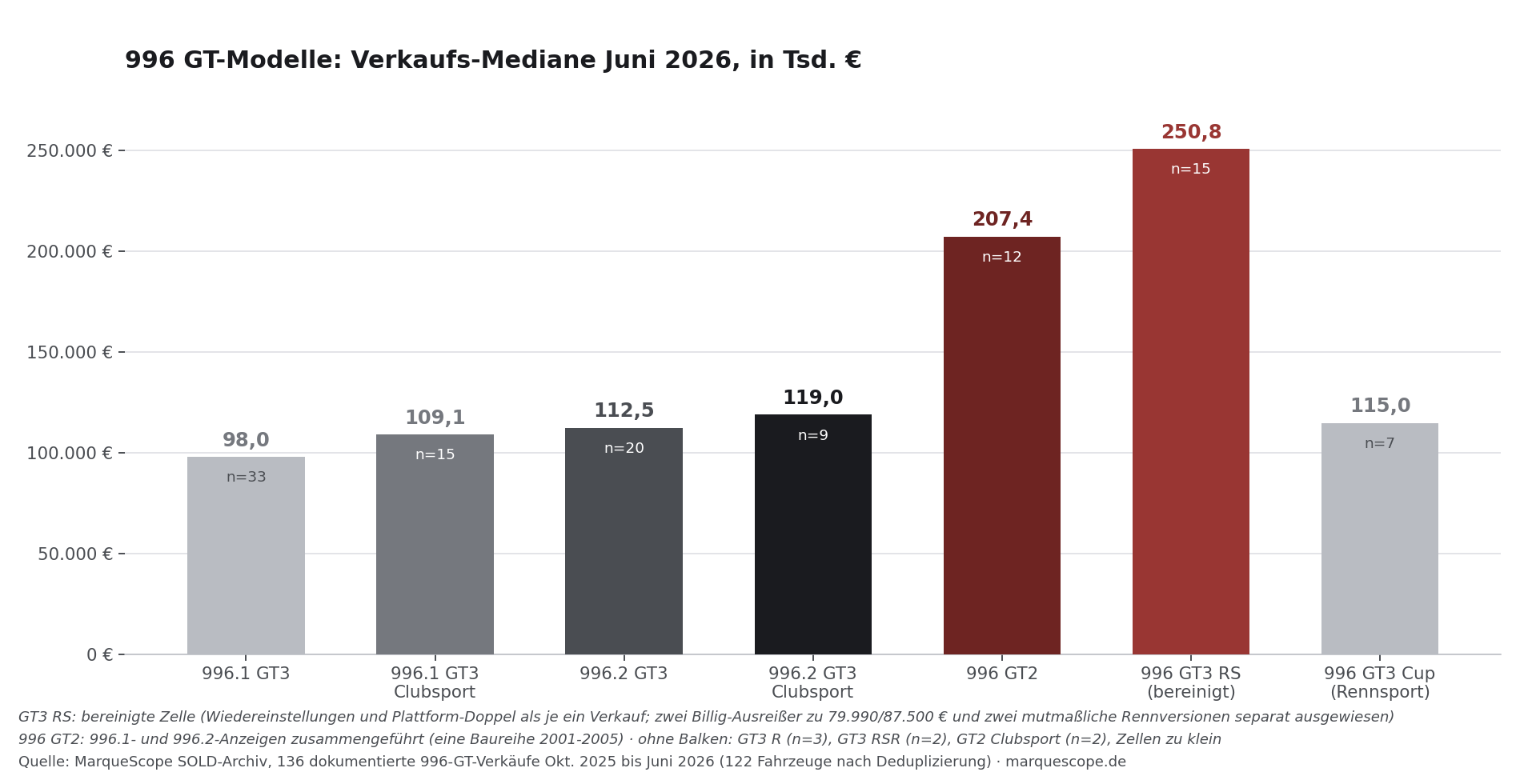
Median sale prices for the 996 GT cells (June 2026) including the Clubsport variants, with the GT3 Cup as a competition reference
What the June 2026 sales data shows +
The cleaned GT3 RS is the most expensive road cell: a €250,846 median across 15 cars, roughly 109 per cent above the list price when new of about €120,000. Twenty-six listings became 15 reliable sales: one car relisted five times counts as a single sale, three duplicate listings were merged, and two cheap outliers and two presumed racing versions are shown separately
The Clubsport premium is confirmed: on the 996.1 GT3 the Clubsport cell achieves €109,106 against €98,000 for the base car (roughly +11 per cent), and on the 996.2 GT3 €119,000 against €112,498 (roughly +6 per cent)
The GT2 market is split in two: nine European sales fall between €144,900 and €249,900 (median €189,900), while three cars offered in the United States made €235,003 to €499,996; across the whole range the median works out at €207,448
The GT3 Cup is the cheapest way into 996 racing: a €115,000 median on 7 sales (from €69,463), which is the price of a 996.2 GT3 road car and less than half a GT3 RS
The road cars line up cleanly: 996.1 GT3 (€98,000) below 996.1 Clubsport (€109,106) below 996.2 GT3 (€112,498) below 996.2 Clubsport (€119,000), with the GT2 (€207,448) and the GT3 RS (€250,846) above them
GT models sell briskly: median times on the market run from 22 days (GT2) to 49 days (996.2 GT3 Clubsport), and the six-figure GT3 RS changes hands after a median of 27 days
Source: MarqueScope market monitoring, export of 11 June 2026. More at marquescope.de
Some surprising findings
Investment potential
1. The GT3 RS is the clear outperformer: Contrary to the common assumption that the GT2, as the most powerful car, would perform best, the GT3 RS has proved by a wide margin the most stable in value. At 50 per cent above its list price when new (averages, as at 2025) it is clearly ahead of every other model; the cleaned median sale price of June 2026 is roughly 109 per cent above that list price.
2. Rarity is not everything: At roughly 324 cars (or, depending on the count, only 95), the 996.2 GT2 is the rarest in the range, yet it is nowhere near the strongest performer. The GT3 RS, at 682 cars and thus more than twice the production, has proved markedly more stable in value.
3. Power does not correlate with appreciation: The most powerful cars, the GT2s, do not perform best. The "weakest" of the special GT models, the GT3 RS with "only" 381 PS, has done best of all.
4. Negative in real terms: Adjusted for inflation since 1999/2004, most of these cars have lost value in real terms. Only the GT3 RS is up once inflation is taken into account.
Assessing each model as an investment
High potential
Porsche 996.2 GT3 RS
As the only car here to have appreciated substantially beyond its list price when new, the GT3 RS has already established itself as a collector car. Even after the recent correction it sits 50 per cent above that price.
The combination of extrovert looks (the RS graphics, the wide body), specific weight-saving measures and a limited run seems to appeal to the market particularly strongly.
The current correction may run on in the short to medium term, but over the long run everything points to continued outperformance. As the most stable 996 GT variant, and with the widest gap between its current value and its low (125 per cent), the GT3 RS remains the most promising of them as an investment.
Moderate potential
Porsche 996.2 GT3
As the only car currently trending upwards, the 996.2 GT3 shows remarkable stability. It has just regained its list price when new and is one of the few here to have recorded no fall since 2023, which argues for solid medium-term potential.
At 2,313 cars it is no rarity, but it seems to be increasingly valued as the affordable way into the Mezger-engined GT world.
Further appreciation in the coming years looks likely, though on a more modest scale than the GT3 RS.
Selective potential
Porsche 996.2 GT2
For all its extreme rarity the 996.2 GT2 has so far shown no exceptional appreciation. Its stability since 2023, though, in a period when the others have been correcting, suggests the market is beginning to recognise it.
At 324 cars from model years 2003-2005, or only 95 on the narrower MK2 definition, it is a genuine exotic, and its rarity could count for still more in future.
Investors should pay particular attention to condition, history and originality here, since on cars this rare those factors weigh heavily on value.
Limited potential
Porsche 996.1 GT3 and 996.1 GT2
Despite their historical significance (the first GT3 of all and the first GT2 of the water-cooled era), neither first-series car has performed convincingly. With current values well below their list prices when new, the short-term investment potential looks limited.
In the 996.1 GT3’s favour is the relatively low entry level of roughly €75,000 (average, as at 2025), which leaves room for moderate gains.
On the 996.1 GT2, the limited run of 963 cars could bring a re-rating over the medium term. Both, though, should be seen primarily as cars for enthusiasts rather than as short-term investments.
The 996 GT model bible
The complete knowledge: the Investor Dossier & Technical Compendium
Detailed expert knowledge on the 996 GT models: weak points, inspection checklists, production figures, value-adding options and price forecasts.
The detailed analysis of how prices have moved, the market cycles and the recent corrections together allow a more realistic forecast of values to 2030.
Forecast table (as at 2025)
Model
Current value (2025)
Forecast 2030
Forecast change
996.1 GT3
€75,000
€85,000 - €95,000
+13 to +27%
996.2 GT3
€105,000
€120,000 - €135,000
+14 to +29%
996.2 GT3 RS
€180,000
€220,000 - €250,000
+22 to +39%
996.1 GT2
€145,000
€160,000 - €180,000
+10 to +24%
996.2 GT2
€158,000
€180,000 - €220,000
+14 to +39%
The forecast was drawn up in 2025 from the 911Finder averages and is deliberately kept separate from the sales data of the June 2026 update: median sale prices from a collector-heavy sales archive and average prices for well-kept cars are different things in method. It is nonetheless striking that the cleaned RS median sale price of June 2026 (€250,846) already sits above the corridor of €220,000-250,000 forecast for 2030.
What shapes this forecast
1. Historical cycles +
The past 25 years show clear cycles, with phases of depreciation, stagnation and growth. The correction now under way on most of these cars argues for a period of consolidation followed by moderate gains.
2. Demographic change +
A new generation of collectors who grew up with the 996 and are now entering their higher-earning years could raise demand moderately.
3. The Mezger engine as a point of difference +
The tough Mezger engine is increasingly recognised as a mark of quality that sets the GT models apart from the regular 996 and gives them a technical standing of their own.
4. The numbers effect +
The limited number of cars available in good condition will shrink further through wear and accidents, which should support prices over the long term.
5. An authentic experience +
As cars become more autonomous and more electric, regard grows for the analogue, immediate experience of driving that the 996 GT2 in particular offers.
Recommended actions
Recommendations for buyers
For investors
Mind the timing: the correction now under way on several of these cars could be a good moment to buy. The historical cycles suggest that corrections are typically followed by stabilisation and then by fresh rises.
Quality over quantity: the price gap between average and outstanding cars is likely to widen further. A first-class example of a "weaker" model can be worth more than an average example of a "stronger" one.
Put documentation first: an unbroken history, service records and originality matter more and more as the cars age. Between comparable cars, take the better documented one.
Go selectively against the trend: as the first GT3 of all, the currently undervalued 996.1 GT3 could be re-rated over the longer term. The extremely rare 996.2 GT2 could also surprise, on rarity alone.
For enthusiasts
Take the chance to get in: at roughly €75,000 (average, as at 2025) the 996.1 GT3 is a comparatively cheap way into the GT world, with the genuine Mezger engine and thoroughbred motorsport DNA.
Look at mechanical condition: in a car you intend to drive, that matters more than absolute originality or low mileage. A car driven and serviced regularly can be in better shape than a "collector’s item" that has stood still.
Bring in a specialist: the particular technical quirks of these GT models justify consulting one before you buy. On the GT2 above all, a fault overlooked can be expensive.
Passion before returns: the past 25 years show that even "investment classics" guarantee nothing. The decision to buy should rest first on enjoying the car.
Conclusion: 25 years of prices, myth and reality
A detailed look at 25 years of prices for the Porsche 996 GT models reveals a far more nuanced picture than is commonly assumed. Against the widespread idea of continuous, strong appreciation, what emerges is a cyclical path with clear phases up and down.
The divergence between the models is particularly striking: the GT3 RS is the clear outperformer at 50 per cent above its list price when new, while other supposedly more exclusive or more powerful variants have stayed below where they started.
The heavy depreciation to 2010, the two-stage recovery that followed and the correction since 2023 show that the market for sporting collector cars follows more complex patterns than is often assumed. Investors should therefore plan on longer horizons and allow for the cycles. The myth that sporting, limited special models automatically rise in value has to be qualified in the light of this data. Even after 20 to 25 years, several of the cars considered here sit well below their starting prices in real terms.
Even so, as the first of their kind the 996 GT models hold a secure place in Porsche history and offer, financial considerations aside, an experience more authentic and purer than any modern high-performance car. It is that combination of historical significance, technical distinctiveness and immediacy that gives them their particular appeal and will keep them attractive to collectors and enthusiasts in future.
The data used in this analysis is based on market observation, sales statistics and expert assessment from a range of sources. The sales data from June 2026 that is marked as such comes from the MarqueScope SOLD archive (October 2025 to June 2026, de-duplicated and cleaned, marquescope.de). All other prices are averages and can vary considerably depending on a car’s specification, condition and mileage. The GT2 production figures follow Adrian Streather’s count for the 996 (1,287 built in total; model years 2001 to 2005: 247, 716, 233, 73 and 18 cars); the narrower MK2 figure of 95 cars from April 2003 (75 left-hand drive, 20 right-hand drive) comes from the German-language Wikipedia. The two counts agree on the MK1 (963 cars up to April 2003); for the later cars a difference of four remains unexplained (Streather: 91 for model years 2004 and 2005, Wikipedia: 95).