The Turbo 3.3, the Turbo 3.6 and the Turbo S special series compared: market phases since 2012, an investment assessment and a forecast to 2030, plus, for the June 2026 update, 86 documented sales records from the MarqueScope SOLD archive.
Price development of the 964 Turbo and Turbo S, 1991-1994
Coveted collector's cars that hold their value
The Porsche 964 was an important transitional generation of the legendary 911, built from 1989 to 1994. The Turbo variants of the 964 are today among the most coveted and most value-stable collector's cars in Porsche history. This analysis compares the price development of the most important Turbo models of the series: the 964 Turbo 3.3 (built 1991-1992, 320 PS, 3,660 cars), the 964 Turbo 3.6 (built 1993-1994, 360 PS, 1,407 cars) and the rare Turbo S variants, above all the 964 Turbo S Leichtbau (built 1992, based on the Turbo 3.3, 381 PS, extremely rare at 86 cars).
The Turbo variants were offered exclusively as Coupés with rear-wheel drive.
For the June 2026 update, the analysis was supplemented by 86 documented sales records from the MarqueScope SOLD archive (October 2025 to June 2026). Seven cars appeared in more than one source at the same time; such duplicate listings are counted as one sale each and are shown in the sales data section. Figures up to 2025 are average prices, the 2026 figures median sale prices; this change of method is declared in every table and chart.
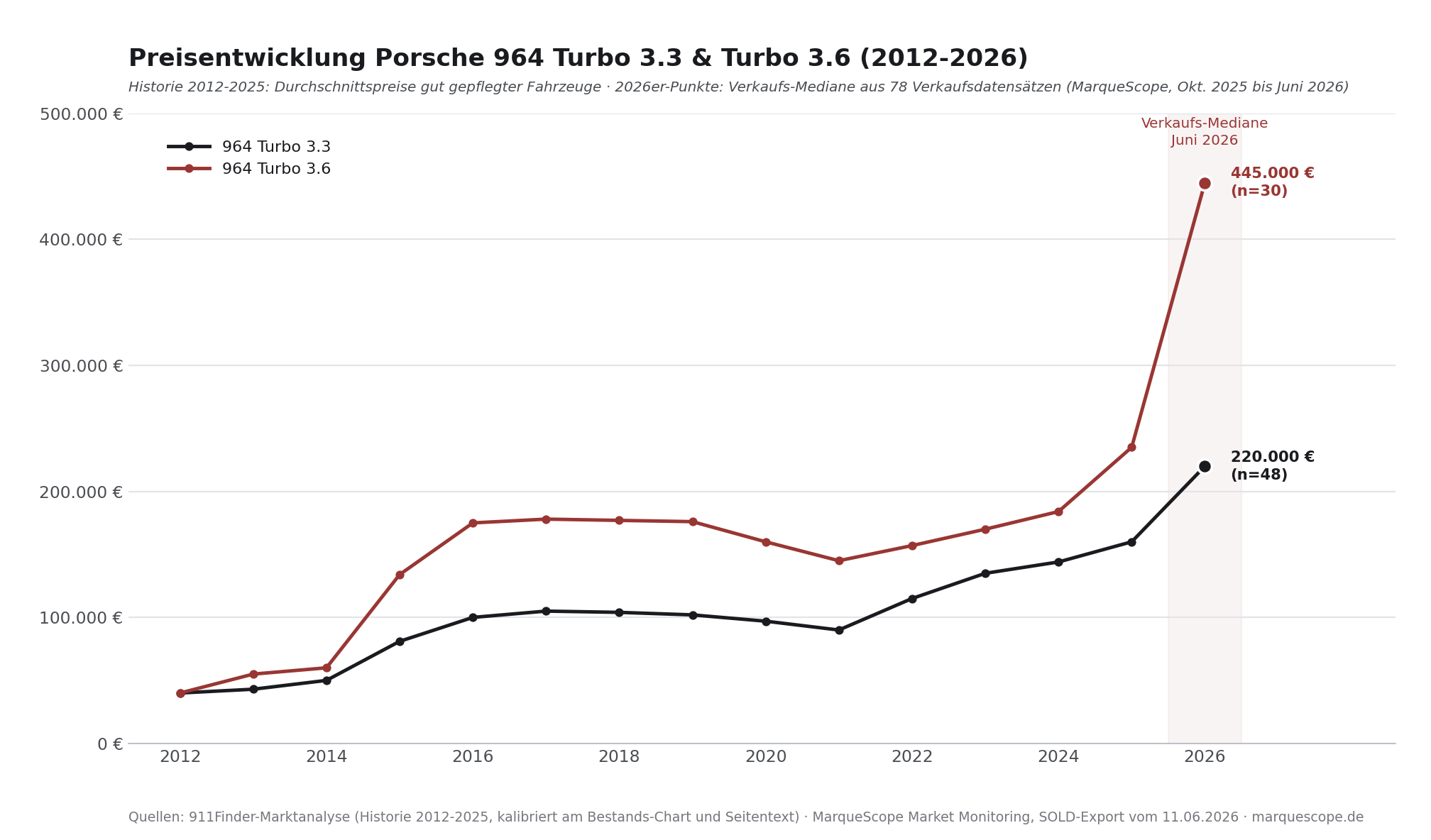
Price development of the 964 Turbo 3.3 and Turbo 3.6, 2012-2025 (average prices), with median sale prices for June 2026; the WLS, Turbo S Leichtbau and Flachbau cells are too small for curves of their own
86
sales records in the MarqueScope archive (October 2025 to June 2026)
€445,000
Median sale price, 964 Turbo 3.6 (June 2026)
€220,000
Median sale price, 964 Turbo 3.3 (June 2026)
€1.8m
The most expensive documented sale: Turbo S Leichtbau
The Turbo variants
Models and market values (May 2025)
964 Turbo 3.3
1991-1992 · 3,660 cars
Power: 320 PS
Market value May 2025: around €160,000, a moderate upward trend
Growth in value since 2012: around +300%
Growth in value since 2021: around +77%
Median sale price June 2026: €220,000 (48 sales records, MarqueScope)
964 Turbo 3.6
1993-1994 · 1,407 cars
Power: 360 PS
Market value May 2025: around €235,000, a strong upward trend
Growth in value since 2012: around +490%
Growth in value since 2021: around +62%
Median sale price June 2026: €445,000 (30 sales records, MarqueScope)
964 Turbo S
1992 Leichtbau · 1994 Turbo 3.6 S · extremely rare
Turbo S Leichtbau (1992): 381 PS, based on the Turbo 3.3, only 86 cars
In 1994 came the Turbo 3.6 S, based on the Turbo 3.6, some with the Flachbau slant-nose front
The earlier estimate on this page: around €650,000. The documented sales from June 2026 are far above that: two Turbo S Leichtbau at €1.4m and €1.8m, one Flachbau at €1,190,270
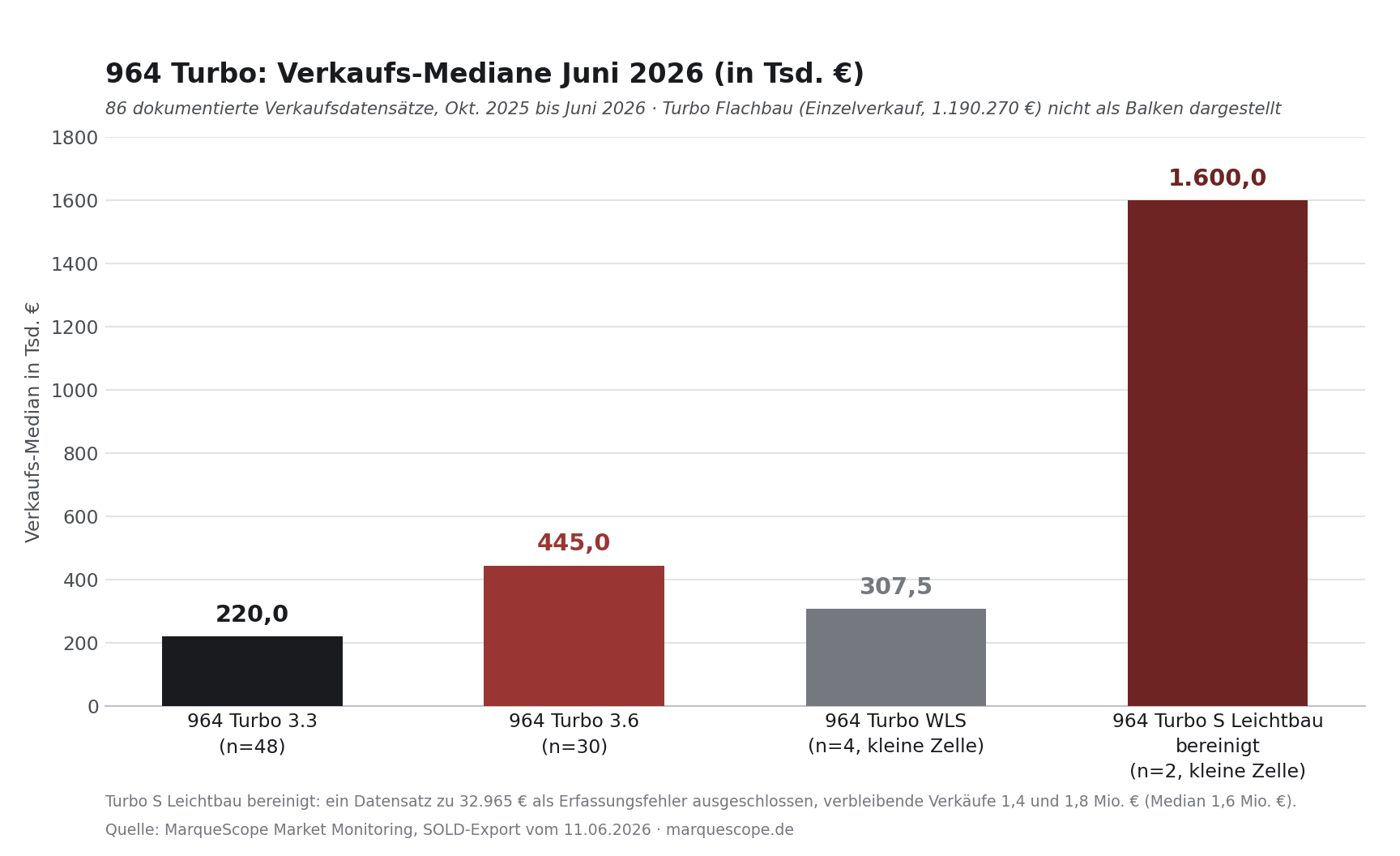
The S variants are not included in the line chart (too few sales for a curve); their median sale prices appear in the bar chart in the sales data section
Conclusions on value development
The most important observations
The price gap between the Turbo 3.3 and the 3.6 has widened from almost nothing in 2012 to around €75,000 in 2025
Both models show a cyclical course with boom, consolidation and correction phases, not a continuous rise
Price volatility is higher than is often assumed, which shows above all in the 20% correction of the Turbo 3.6 between 2019 and 2021
Contrary to the thesis of a current market consolidation, the Turbo 3.6 in particular has shown very dynamic price development since 2023
The Turbo 3.3 is developing comparatively more moderately, which points to a differentiation within the collector market
Particularly notable: while both models still had a similar market value in 2012, in May 2025 the Turbo 3.6 sat around 47 per cent above the Turbo 3.3, an expression of growing specialisation in the market and of the regard for the rarer, more powerful variant. The median sale prices from June 2026 draw an even clearer picture: at €445,000 against €220,000, the Turbo 3.6 most recently traded at roughly twice the Turbo 3.3; the step up from May 2025 reflects the change of method from average price to median sale price as well as the dynamics of the market.
Documented sales rather than asking prices
Sales data, June 2026
86 documented sales records for the 964 Turbo from the MarqueScope SOLD archive (October 2025 to June 2026; records without a price and below €15,000 removed globally). Prices correspond to the last recorded asking price of the car sold. Seven cars appeared in more than one source at the same time (four in the 3.3 cell, three in the 3.6 cell); these duplicate listings are counted as one sale each, so the 86 records correspond to 79 cars. This has practically no effect on the medians: deduplicated, €217,500 instead of €220,000 for the Turbo 3.3, unchanged at €445,000 for the Turbo 3.6.
Model
Sales
Median
Range
Median km
Days on market
964 Turbo 3.3 (1991-1992)
48
€220,000
€48,000 - €1,500,000
97,800
22 days
964 Turbo 3.6 (1993-1994)
30
€445,000
€348,000 - €850,000
98,600
54 days
964 Turbo WLS (factory power enhancement)
4
€307,450
€185,000 - €476,000
103,916
4 days
964 Turbo S Leichtbau (cleaned)
2 of 3
€1,600,000
€1,400,000 - €1,800,000
10,335
0 days
964 Turbo Flachbau (first registered 1994)
1
€1,190,270
-
38,056
15 days
Both extremes of the 3.3 cell should be read with caution: the €48,000 record is listed as a Tiptronic, but from the factory the 964 Turbo came exclusively with a manual gearbox, which suggests a project car or a recording error. The €1,500,000 record concerns a partly restored 1990 car far outside the market band, presumably a car with special status or, again, a recording error. Neither end affects the median. In the Turbo S Leichtbau cell, a third record at €32,965 was excluded as a clear recording error: the figure is implausible for a collector car trading in seven figures, and the other sales in the same cell stand at €1.4m and €1.8m. The two Leichtbau cars counted (first registered 1992) showed 600 km and 20,070 km; a time on the market of 0 days means the car was already marked as sold when it was first recorded. First registrations in the 3.3 cell range from 1990 to 1993 in the archive (the core being 1991/1992). Cells with fewer than 8 sales (WLS, Turbo S Leichtbau, Flachbau) are only of limited reliability. Every 964 Turbo left the factory with a manual gearbox; isolated automatic or Tiptronic flags in the archive are platform noise, so no comparison of transmissions is made.
For dealers & professionals: This table is an extract. The full MarqueScope dashboard gives you active listings, the complete SOLD archive, days on market, price deltas and options scores for 8 premium marques, turning 3 hours of research into 5 minutes. Discover MarqueScope →
Median sale prices June 2026 in thousands of euros; the Turbo S Leichtbau cleaned of one recording error, the single Flachbau sale not shown as a bar
What the June 2026 sales data shows +
The core finding: at a median of €445,000, the Turbo 3.6 traded at roughly twice the Turbo 3.3 at €220,000 (a ratio of 2.0:1). In May 2025 the average figures for the two models were around €75,000 apart; the step up is explained by market dynamics plus the change of method to the median sale price
The Leichtbau league: the two Turbo S Leichtbau sales counted stand at €1.4m and €1.8m (both first registered in 1992, one with only 600 km), three to four times the Turbo 3.6 median and a price class of its own
The single Flachbau sale: a 1994 car with the slant-nose front changed hands for €1,190,270 (38,056 km, located in the USA), only one record, but evidence of the special position of the factory special series
The 3.3 range is enormous: €48,000 to €1,500,000 across 48 records, with both ends conspicuous (see the note to the table); the middle half of the market traded between around €194,000 and €250,000
At a median of €307,450, the Turbo WLS sits between the 3.3 and the 3.6, though with only 4 sales it carries no statistical weight
The pace of the market: the Turbo 3.3 sold after a median of 22 days, the Turbo 3.6, at considerably higher prices, only after 54 days; the median mileages of the two cells are practically level at 97,800 and 98,600 km
Source: MarqueScope market monitoring, export of 11 June 2026. More at marquescope.de
Market analysis
The five market phases since 2012
Phase 1: a moderate beginning (2012-2014) +
In this early phase the prices of the two models were still close together:
Turbo 3.3: a rise from around €40,000 to €50,000 (+25%)
Turbo 3.6: a rise from around €40,000 to €60,000 (+50%)
The price difference between the two models slowly began to establish itself
Phase 2: explosive growth (2014-2016) +
This phase marks the most dramatic rise in the whole period observed:
Turbo 3.3: a rise to around €100,000 (+100% in two years)
Turbo 3.6: a rise to around €175,000 (+190% in two years)
The price difference between the models widened enormously, to around €75,000
Phase 3: stabilisation at a high level (2016-2019) +
After the explosive growth came a phase of consolidation:
Turbo 3.3: stable prices around €100,000-€105,000
Turbo 3.6: stable prices around €175,000-€180,000
This phase confirmed the established price levels after the strong rise
Phase 4: market correction (2019-2021) +
Contrary to the narrative of a steady rise that has dominated so far, the chart shows a clear phase of correction:
Turbo 3.3: a fall to around €90,000 (-10%)
Turbo 3.6: a fall to around €145,000 (-20%)
This correction coincided with the COVID-19 pandemic
Phase 5: a renewed period of growth (2021-2025) +
After the correction, a renewed and this time differentiated upward trend set in:
Turbo 3.3: a moderate rise to around €160,000 (+77% in four years)
Turbo 3.6: a very strong rise to around €235,000 (+62% in four years)
From 2023 in particular, the Turbo 3.6 shows exceptional value development
An important insight for investors: The chart shows that the market for 964 Turbos is considerably more volatile than is often presented. The 20% correction on the Turbo 3.6 between 2019 and 2021 makes plain that even classic investments regarded as safe are subject to swings in the market. At the same time, the current dynamic development of the Turbo 3.6 demonstrates that strong upward movements are possible again after a correction.
2025-2030
Price development over the next three to five years
964 Turbo 3.3
Forecast for 2030: around €190,000-€210,000
Short term (2025-2027): probably a continued moderate rise of 5-8% a year, provided no general market correction occurs
Medium term (2028-2030): stabilisation, with annual rates of increase of 3-5%
The earlier figure of €230,000-€250,000 appeared too optimistic
Placing this as at June 2026: at €220,000, the median sale price is already above that 2030 range; alongside market dynamics, the change of method from average price to median sale price contributes to this
964 Turbo 3.6
Forecast for 2030: around €320,000-€350,000
Short term (2025-2027): a continued strong rise of 8-12% a year, though with the possibility of consolidation in between
Medium term (2028-2030): more moderate increases of 5-8% a year after the current dynamic phase
Revised from the previous forecast of €400,000-€450,000, which appeared too optimistic
Placing this as at June 2026: at €445,000, the median sale price is already clearly above the 2030 range and even in the region of the forecast once discarded; bear in mind the change of method to the median sale price
964 Turbo S (Leichtbau and 3.6 S)
Forecast for 2030: around €800,000-€950,000
Short term (2025-2027): probably more stable value development than on the less rare models, with annual increases of 6-9%
Medium term (2028-2030): continued growth in value on account of the extreme rarity, with annual rates of 4-7%
Placing this as at June 2026: two documented Leichtbau sales (€1.4m and €1.8m) and one Flachbau sale (€1.19m) are already above this range today; for the special series the forecast has been overtaken, and the range of €1.2m-€1.5m once discarded is already being reached by the market
Market cycles and volatility
A more complex picture than assumed
The Porsche 964 Turbo market shows clear cyclical elements, not a continuous rise
The correction phase between 2019 and 2021 (with price falls of as much as 20%) refutes the narrative of steady growth in value
The current strong upward movement of the Turbo 3.6 stands in contrast to the thesis of a market consolidation
The price dynamics show a growing differentiation between the model variants, with rarity and power acting as the drivers of value
Is an investment still worthwhile?
Investment assessment
964 Turbo 3.3 · rated 3.5 out of 5 +
Advantages: Good value for money within the segment; moderate but steady growth in value since the 2019-2021 correction; more robust engineering than the 3.6.
Disadvantages: Higher production numbers; less exclusivity; less dynamic price development than the 3.6.
Conclusion: A solid investment with moderate upside. Particularly recommendable for enthusiasts who also want to drive the car. The price difference from the 3.6 (€75,000 on the average figures from May 2025, and as much as €225,000 on the median sale prices from June 2026) makes the 3.3 the more attractive way into the world of the 964 Turbos.
964 Turbo 3.6 · rated 4 out of 5 +
Advantages: Considerably rarer than the 3.3; stronger growth in value; currently very dynamic price development; greater performance potential.
Disadvantages: A high entry price (average figure May 2025: around €235,000; median sale price June 2026: €445,000); a tendency towards higher volatility, as seen in the 2019-2021 correction.
Conclusion: A very good investment with above-average potential for growth in value. The current strong upward trend could, however, indicate short-term overheating. A tactical entry after a possible consolidation could make sense.
964 Turbo S · rated 5 out of 5 +
Advantages: The most extreme rarity of the 964 range; the highest power output; iconic status; excellent stability in value.
Disadvantages: A very high entry price; low market liquidity on account of the rarity.
Conclusion: A premium investment with excellent long-term potential, though realistic only for wealthy collectors. The extreme rarity (Leichtbau: only 86 cars) should protect the Turbo S from stronger market corrections. The documented sales from June 2026 (€1.19m to €1.8m) confirm its special position.
Buying recommendation by budget
Budget
Recommended
Reasoning
up to €250,000
964 Turbo 3.3 (1991-1992)
The largest supply in the series (48 sales records), median sale price €220,000; condition and history decide where a car sits in the enormous range
€250,000-€350,000
964 Turbo WLS
The rare factory power enhancement as an intermediate step, median sale price €307,450 (only 4 sales, of limited reliability)
€350,000-€500,000
964 Turbo 3.6 (1993-1994)
A considerably smaller run than the 3.3, the best documented price dynamics, median sale price €445,000
from €1m
964 Turbo S Leichtbau / Flachbau
The collector league, with documented sales between €1.19m and €1.8m
Budget ranges derived from the median sale prices of the MarqueScope SOLD archive (June 2026). Within each cell, prices vary considerably by condition, history and mileage; details and notes on artefacts in the sales data section.
The 964 Turbo model bible
The complete knowledge: the Investor Dossier & Technical Compendium, in German
Detailed expert knowledge on the 964 Turbo and Turbo S: weak points, inspection checklists, production figures, value-enhancing options and price forecasts.
Turbo 3.3: the current moderate upward trend, without overheated price dynamics, offers a favourable moment to enter
Turbo 3.6: given the currently very dynamic rise in prices, waiting could make sense, in order to see whether a short-term correction or consolidation comes
Turbo S (Leichtbau, 3.6 S): given the extreme rarity there is no ideal moment to buy; the cars available are scarce and rarely offered on the market. The few documented sales in 2026 lay between €1.19m and €1.8m
Selection criteria for an investment that holds its value +
Original condition: unmodified cars with the original engine and gearbox achieve considerably higher prices
Documentation: a complete history, service records and the original sales paperwork
Mileage: cars with less than 50,000 km have the best potential for growth in value
Colour combinations: rare original paint can justify a premium of 5-15%
Early production numbers: on the Turbo 3.6 in particular, early cars can carry a collector premium
Costs to budget for beyond the purchase price +
Prospective buyers should budget for the following annual costs:
Insurance: €2,000-€5,000 for comprehensive cover with an appropriate sum insured
Servicing: €2,500-€5,000 for regular servicing by specialist workshops
Storage: €1,200-€3,600 for climate-controlled storage (€100-€300 a month)
Swings in value: market corrections of 10-20% are possible and should be allowed for
The balance
Conclusion
The key statements
The market for 964 Turbos shows clear cyclical elements, with boom, correction and recovery phases
The price difference between the Turbo 3.3 and the 3.6 has widened considerably since 2012, which underlines the growing regard for rarity and power
The current dynamic development of the Turbo 3.6 contradicts the thesis of a general market consolidation
The sales data from June 2026 (86 records, MarqueScope) confirm the spread: a median sale price of €445,000 for the Turbo 3.6 against €220,000 for the Turbo 3.3, and the Turbo S special series from around €1.2m
The outlook
The existing 2030 forecasts (€190,000-€210,000 for the Turbo 3.3, €320,000-€350,000 for the Turbo 3.6) are already reached or exceeded by the median sale prices from June 2026 (€220,000 and €445,000); they need to be reassessed, bearing the change of method in mind
Despite the volatility observed, the 964 Turbo in every variant remains an attractive collector's car with solid potential for growth in value
The 911Finder assessment
The Porsche 964 Turbos combine historical significance, technical refinement and limited availability: a combination that will secure them a special status among collectors and investors in the long term too.
The data used in this analysis are based on market observation, sales statistics and expert assessment from various sources. The sales data from June 2026 marked as such come from the MarqueScope SOLD archive (October 2025 to June 2026, duplicate listings counted as one sale each, marquescope.de). All other prices are average figures and can vary considerably by individual specification, condition and mileage.