From "widowmaker" to collector classic: market phases, market values (as at 2025), investment potential and a forecast to 2030, supplemented by 174 documented sales from the MarqueScope SOLD archive (as at June 2026).
This analysis examines the historical price trends of the legendary Porsche 911 Turbo (type 930), shown in 1974 and built until 1989. Drawing on extensive data, it identifies trends, sets out where the investment potential lies and offers forecasts to 2030. The prices on this page rest on the 911Finder series with data as at 2025. The June 2026 update adds documented sales for the first time: 194 sale records from the MarqueScope SOLD archive (October 2025 to June 2026), reduced to 174 analysed sales after cleaning; the method is set out in the sales-data section.
The material should be of value to collectors and investors alike who take an interest in this iconic car, which went down in history as Porsche’s first production turbo and earned the nickname the Widowmaker .
260-330 PS
Turbo 3.0 to Turbo 3.3
2,819
Turbo 3.0s built
194
sale records in June 2026, of which 174 were analysed
+45 %
G50 premium: the 1989 five-speed against the 3.3 Coupé (€215,000 against €147,950)
Model specifications and distinguishing features
The Turbo variants of the type 930
911 Turbo 3.0
1975-1977 · 2,819 built
3.0-litre flat-six with a KKK turbocharger and no intercooler
191 kW (260 PS) at 5,500 rpm, 343 Nm at 4,000 rpm
0-100 km/h in 5.5 s, top speed 250 km/h
Porsche’s first production turbo, with fierce acceleration and considerable lag, hence the "widowmaker" nickname
Heavily flared arches and the distinctive "whale tail" rear wing
Original price: DM 65,800 (1975)
Market value: roughly €131,000 (911Finder series, average price, as at 2025); exceptionally well documented or unusually original cars can sit well above that
June 2026 sales data: a €178,000 median on 25 analysed sales (MarqueScope SOLD archive); US-specification cars separately at €119,000 (7 sales)
911 Turbo 3.3
1978-1989 · 18,492 built
3.3-litre flat-six with a KKK turbocharger and an intercooler
221 kW (300 PS), and from model year 1983 243 kW (330 PS), 412 Nm at 4,000 rpm
0-100 km/h in 5.3 s, top speed 260 km/h
Better behaved thanks to the intercooler and larger brakes, and from 1989 with a five-speed gearbox
Original price: DM 74,000 (1978)
Market value: roughly €122,000 (as at 2025), and the five-speed 1989 model year roughly €127,000; the larger production run keeps it at the bottom of the Turbo field on price
June 2026 sales data: a €147,950 median on 82 Coupé sales (European specification, four-speed); the five-speed 1989 model year achieved a €215,000 median (only 5 sales)
911 Turbo 3.3 Targa
1987-1989 · only 297 built
3.3-litre flat-six with a turbocharger and an intercooler
243 kW (330 PS)
The first open Turbo, with the characteristic roll-over bar and removable roof panel
Original price: DM 84,000 (1987)
Market value: very rare and therefore wanted; it is not tracked as a separate line in the 911Finder series, so no reliable figure of its own can be given at present
June 2026 sales data: only two documented individual sales (€215,000 European specification, €176,000 US specification), still not a cell that carries any weight
911 Turbo 3.3 Cabriolet
1987-1989 · only 625 built
3.3-litre flat-six with a turbocharger and an intercooler
243 kW (330 PS)
The fully open Turbo, and very rare
Original price: DM 90,000 (1987)
Market value: roughly €131,000 (as at 2025), which, contrary to the common assumption, is not below but slightly above the Turbo 3.3 Coupé
June 2026 sales data: a €159,900 median on 10 sales, again above the Coupé; the five-speed Cabriolet of model year 1989 stood at €169,915 (12 sales)
Price Trends
Key findings from the analysis
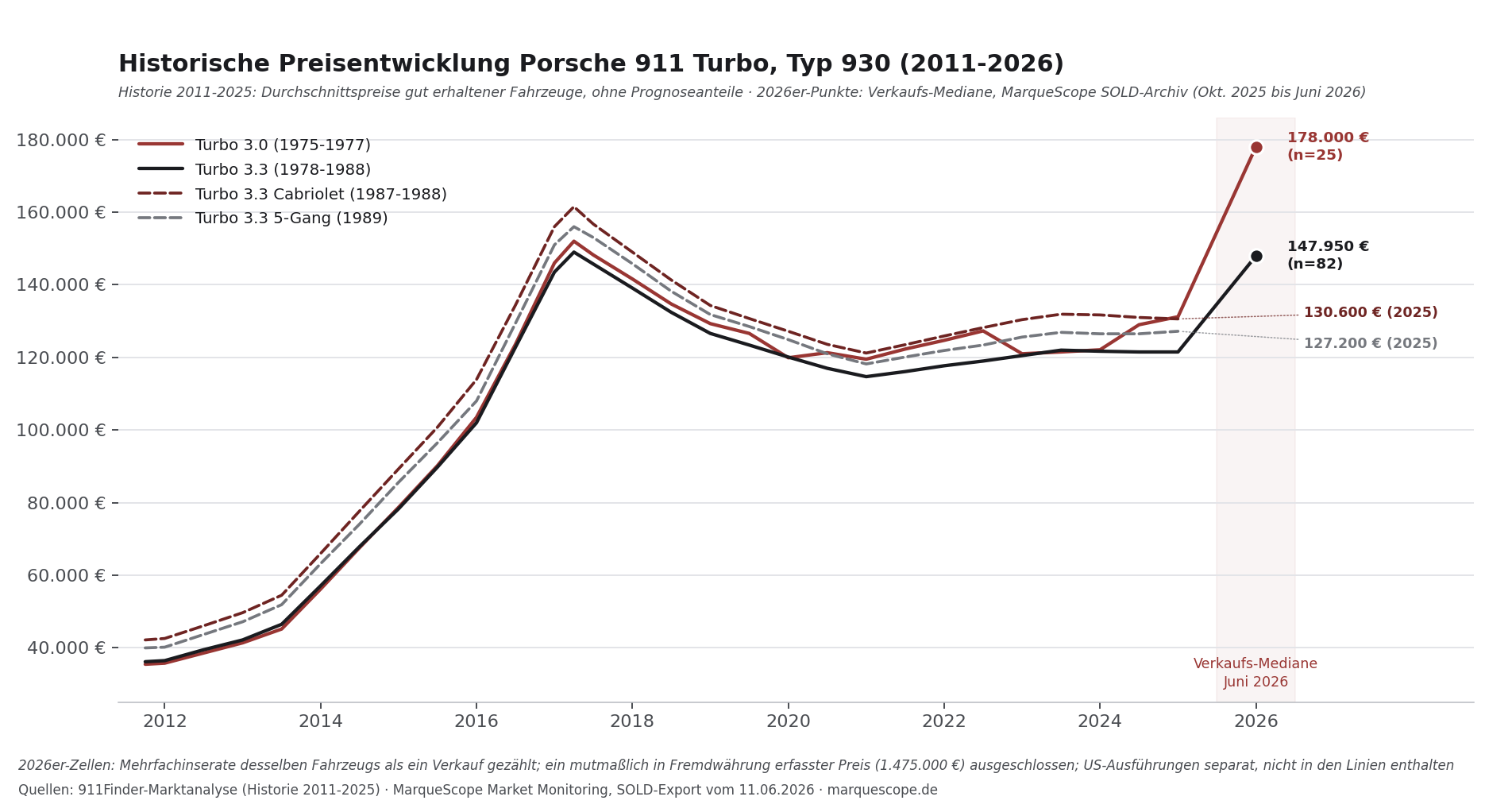
Historical price trends for the 911 Turbo (type 930) 2011-2025 (average prices for well-preserved cars) with June 2026 median sale prices for the Turbo 3.0 and Turbo 3.3; sources: 911Finder market analysis and the MarqueScope SOLD archive
1. Steady growth (2012-2016) +
Strong, continuous appreciation across every Turbo variant
From roughly €35,000-45,000 to roughly €100,000-115,000
Annual appreciation of roughly 25-30 per cent
All the models moving broadly in parallel, with small differences in price
2. An explosive rise (2016-2017) +
A dramatic, steep rise within a single year
Peak values of roughly €150,000-160,000 reached in spring 2017
Appreciation of roughly 40 per cent in one year
An all-time high for every model variant
3. A marked decline (2017-2021) +
A significant fall of roughly 20-25 per cent over four years
Down to roughly €115,000-121,000 at the 2021 low
Every model loses value to a similar degree
This correction is central to judging today’s asking prices realistically
4. Stabilisation and a moderate recovery (2021-2025) +
A moderate recovery, with slight fluctuations
Slow appreciation to roughly €122,000-131,000 (as at 2025)
Values remain well below the 2017 peak
A sign of consolidation after the boom cycle
5. The 2026 sales year: documented sales for the first time +
A change of method: the figures up to 2025 are average prices from the series, while the 2026 points are median sale prices from the MarqueScope SOLD archive (October 2025 to June 2026); the two are not directly comparable
Turbo 3.0: a €178,000 median sale price (25 sales) against a series value of roughly €131,000 in 2025
Turbo 3.3 Coupé (four-speed): a €147,950 median sale price (82 sales) against a series value of roughly €122,000 in 2025
The Cabriolet and five-speed lines end in 2025; their June 2026 median sale prices appear in the table in the sales-data section
At roughly €30,000, the spread between the Turbo 3.0 and the Turbo 3.3 is markedly wider in the sales data than in the series
Key findings from the chart +
Cyclical rather than continuous: the chart shows a clearly cyclical path, with a boom (2012-2017), a correction (2017-2021) and stabilisation (2021-2025)
The peak came as early as 2017: prices topped out in 2017
Little differentiation between the models up to 2025: in the series the price differences between the model variants come to at most €10,000-15,000
June 2026 median sale prices: the zone marked in red shows the change of method; at €178,000 (Turbo 3.0) against €147,950 (Turbo 3.3), the variants separate clearly again in the documented sales for the first time
Documented sales · MarqueScope SOLD archive
Sales data, June 2026
The basis is 284 de-duplicated sale records from the MarqueScope SOLD archive (October 2025 to June 2026). 89 records without a usable price and one with an obviously erroneous residual price (€16) were set aside, leaving 194 sale records. 19 repeat listings of the same car, recognisable by identical or almost identical mileage and sometimes appearing across several sources, were counted as one sale each (175 cars); one price presumably recorded in a foreign currency was excluded. That leaves 174 salesanalysed. European and US specifications are shown separately, and the five-speed 1989 model year (G50 gearbox) has rows of its own. Prices are the last recorded asking price of the car that sold.
Days on market = the median listing duration in days, rounded; 0 days means the listing appeared in only one capture run. US = US specification or a re-import according to the listing, regardless of where the sale took place. Four individual sales are not shown as rows of their own (Turbo 3.3 Targa €215,000, Turbo 3.3 US Targa €176,000, Turbo 3.3 WLS €209,000, Flachbau Targa €312,435), nor are two RUF BTR conversions (€159,000 and €319,930), which as conversions belong to no production cell. Rows with fewer than 10 sales carry only limited weight. The bottom of the 3.3 range is marked by a car with 124,011 km (€52,664 after a price cut) and by a declared restoration project (€59,930), the top by one showing just 70 km (€265,000). A sale recorded at €1,475,000 by a Danish seller (first registered 1978, 26,000 km) was excluded as a presumed currency or recording error; read as Danish kroner the figure would be roughly €198,000. One car recorded as a five-speed Cabriolet with a first registration of June 1988 falls before the G50 window (from model year 1989); it is flagged as a plausibility anomaly but left in the cell. Individual listings from the four-speed years (first registered 1983-1988) mention a five-speed gearbox; those entries were treated as listing noise or possible conversions. Every other first registration fits the production period of its group.
For dealers & professionals: This table is an extract. The full MarqueScope dashboard gives you active listings, the complete SOLD archive, days on market, price deltas and options scores for 8 premium marques, turning 3 hours of research into 5 minutes. Discover MarqueScope →
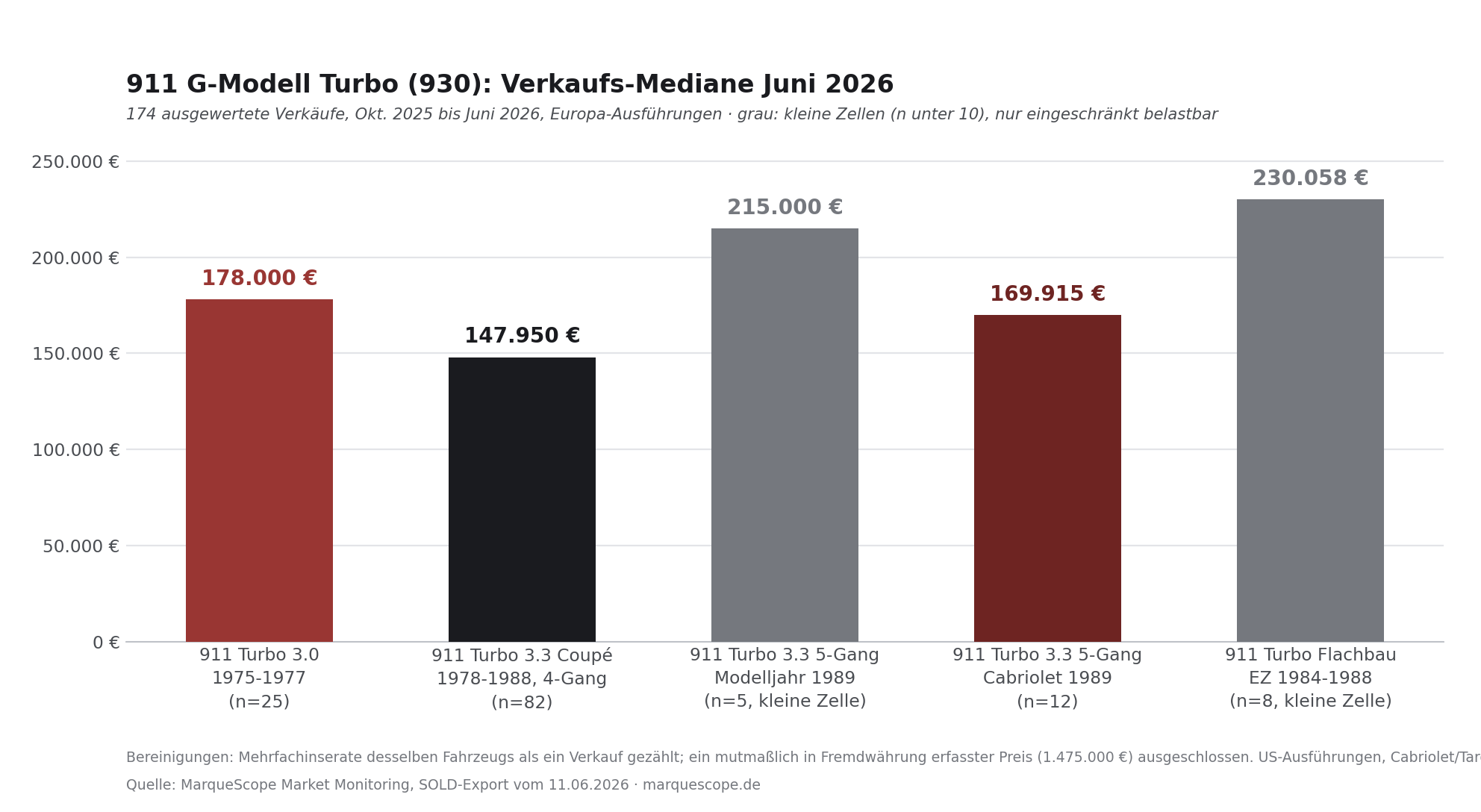
June 2026 median sale prices by variant (European specifications); small cells shown in grey
What the June 2026 sales data shows +
A G50 premium on the Coupé: the five-speed 1989 model year achieves a €215,000 median against €147,950 for the four-speed Coupés of 1978-1988, a premium of roughly 45 per cent, though on only 5 sales
The original Turbo 3.0 sits above the 3.3: a €178,000 median against €147,950 (roughly +20 per cent), and that despite a higher median mileage (117,999 km against 86,486 km); the small production run of 2,819 cars (against 18,492 Turbo 3.3s) and the collector status of the first production turbo support that premium
The Flachbau is a class of its own: a €230,058 median (8 sales) across an extreme range from €122,550 (a car located in the United States) to €990,930 for one showing just 908 km
The US discount is pronounced only on the 3.0: US-specification Turbo 3.0s achieve a €119,000 median, roughly a third less than European cars; on the Turbo 3.3, US Coupés at €147,090 are effectively level with Europe
Cabriolet above Coupé: the Turbo 3.3 Cabriolet achieves a €159,900 median (10 sales) against €147,950 for the Coupé, confirming what the series indicated; on the five-speed 1989 model year the picture reverses (Cabriolet €169,915, Coupé €215,000)
US imports take patience: a median of 83 days on the market for the US Turbo 3.0 against 35 days for European cars; the quickest to sell was the US Turbo 3.3 Coupé, at 23 days
Source: MarqueScope market monitoring, export of 11 June 2026. More at marquescope.de
The series values and the median sale prices compared
Investment potential
All Turbo models: For the years up to 2025 the chart shows every model variant performing similarly, with relatively small differences. The sharp distinction previously drawn between "high", "medium" and "moderate" potential cannot be justified on that data. The June 2026 median sale prices do, however, point to a stronger separation once again: the Turbo 3.0, the five-speed 1989 model year and the Flachbau pull away from the Turbo 3.3.
Assessing the variants (as at 2025 and June 2026)
Variant
Value approx. (as at 2025)
Median sale price (June 2026)
Where it fits
Turbo 3.0 (1975-1977)
€131,000
€178,000 (25 sales)
Close to the later cars in the series; in the June 2026 sales data the original Turbo pulls clearly away from the high-volume Turbo 3.3, and only the small five-speed 1989 model year and the Flachbau achieve higher medians
Turbo 3.3 Cabriolet (1987-1988)
€131,000
€159,900 (10 sales)
Contrary to earlier assumptions it sits not below but above the Turbo 3.3 Coupé; the sales data confirms it
Turbo 3.3 five-speed (1989)
€127,000
€215,000 (only 5 sales)
The final year of production, with the improved five-speed gearbox; the highest production-car median in June 2026, though on thin data
Turbo 3.3 (1978-1988)
€122,000
€147,950 (82 sales)
The largest production run in the range and the lowest prices in the Turbo field; at the same time by far the most liquid sub-market
The 2025 figures come from the 911Finder series (average prices for well-preserved cars) and, rounded to the nearest thousand, match the end points of the chart; the table was aligned with the chart in the course of the 2026 consistency audit. The June 2026 median sale prices come from the MarqueScope SOLD archive (documented sales October 2025 to June 2026, European specifications, cleaned as described in the sales-data section). The gap between the two columns reflects not only the market but also the change of method, from an average price to a median sale price.
Buying recommendation by budget (June 2026)
Budget
Recommended
Reasoning
up to €130,000
Turbo 3.0/3.3, US specification
Re-imports are the cheapest way in: a €119,000 median for the US Turbo 3.0, and individual US 3.3 sales from €109,000
€130,000-€155,000
Turbo 3.3 Coupé (1978-1988)
Median €147,950; with 82 sales, by far the most liquid part of the 930 market
€155,000-€175,000
Turbo 3.3 Cabriolet / five-speed Cabriolet
Medians of €159,900 and €169,915; open variants with thin supply
€175,000-€200,000
Turbo 3.0 (1975-1977)
Median €178,000; the original Turbo, with a premium for rarity and collector appeal
€200,000-€230,000
Turbo 3.3 five-speed Coupé (1989)
Median €215,000 on only 5 sales; the sought-after final model year with the G50 gearbox
over €230,000
Turbo Flachbau
Median €230,058; a very mixed field, with a range up to €990,930
The budget bands are based on the June 2026 median sale prices (MarqueScope SOLD archive). Condition, history and mileage shift the realistic entry price more than the variant does; small cells (the five-speed Coupé, the Flachbau) carry only limited weight.
Keep prices realistic: actual market values sit well below the fantasy figures often quoted. Buying decisions should rest on realistic price data
Quality before variant: the relatively small price differences between the variants in the series suggest that quality and documentation matter more to value than the specific variant; the wide ranges in the June 2026 sales data underline it
Allow for the cycles: the cyclical character of the market should shape the timing of any purchase or sale
Work out the real return: any calculation should include the cost of maintenance, insurance and the loss of value from use
For enthusiasts +
Focus on the driving: more moderate prices make these historically important cars easier to reach
Choose by preference: the relatively small price differences in the series allow you to buy what you like; the June 2026 medians do, however, show noticeable premiums for the Turbo 3.0, the five-speed 1989 model year and the Flachbau
Line up technical support: the particular demands of the turbocharged engine still call for specialist knowledge in servicing and repair
Budget for the real running costs: they remain high and should be part of the decision
Outlook
Forecast to 2030
The forecast
All Turbo variants: starting from the 2025 position (roughly €122,000-131,000), 2-4 per cent a year works out at roughly €135,000-160,000 by 2030
Where June 2026 fits: the documented median sale prices (€147,950 to €215,000 depending on the variant) sit above the 2025 series values; besides a genuine pick-up in the market, the change of method from an average price to a median sale price contributes to that
Annual appreciation: roughly 2-4 per cent, slightly above inflation
Possible differentiation: in the series up to 2025 the gaps between the variants stayed moderate; the June 2026 median sale prices point instead to a wider spread, and whether it holds will only be clear at the next data point
Factors shaping value
Market cycles: the clearly cyclical character of this market points to further swings ahead
Rarity: in the series up to 2025, production numbers had only a weak effect on price differences; the June 2026 sales data, by contrast, shows clear premiums for rarity again (Turbo 3.0, the five-speed 1989 model year, the Flachbau)
Differentiation by condition: in future, state of preservation and documentation are likely to weigh more heavily than the specific variant
Saturation: the marked decline after 2017 suggests the market may be saturated at the top end
The balance
Conclusion
The Porsche 911 Turbos of 1974-1989 remain impressive cars, historically important and lastingly collectable. The updated market analysis shows, though, that their financial potential should be judged far more realistically than it has been.
The small price differences between the variants in the series up to 2025 stand in contrast to the strong hierarchy previously assumed. That lets enthusiasts buy more according to their own preference than to investment considerations. The June 2026 median sale prices do show, however, that the original Turbo 3.0 (€178,000), the five-speed 1989 model year (€215,000, a small cell) and the Flachbau (€230,058) are pulling away from the Turbo 3.3 (€147,950) more clearly again; how much of that is the market moving and how much the change of method will only be clear at the next data point.
For the future, moderate growth of 2-4 per cent above inflation is realistic, with the quality and documentation of an individual car likely to matter more and more than its specific variant.
The 911Finder assessment
The Porsche 911 Turbo remains a fascinating piece of motoring history whose worth cannot be measured in financial terms alone: its unique character on the road and its historical significance as Porsche’s first production turbo make it a desirable classic regardless of what the market does.
The data used in this analysis is based on market observation, sales statistics and expert assessment from a range of sources (the series values are as at 2025). The sales data from June 2026 that is marked as such comes from the MarqueScope SOLD archive (October 2025 to June 2026, de-duplicated and cleaned; marquescope.de). All other prices are averages and can vary considerably depending on a car’s specification, condition and mileage.