From homologation model to automotive investment: the historical value development of the Carrera RS 2.7 in six market phases, with forecasts to 2031 and, for the June 2026 update, 17 documented sales from the MarqueScope SOLD archive.
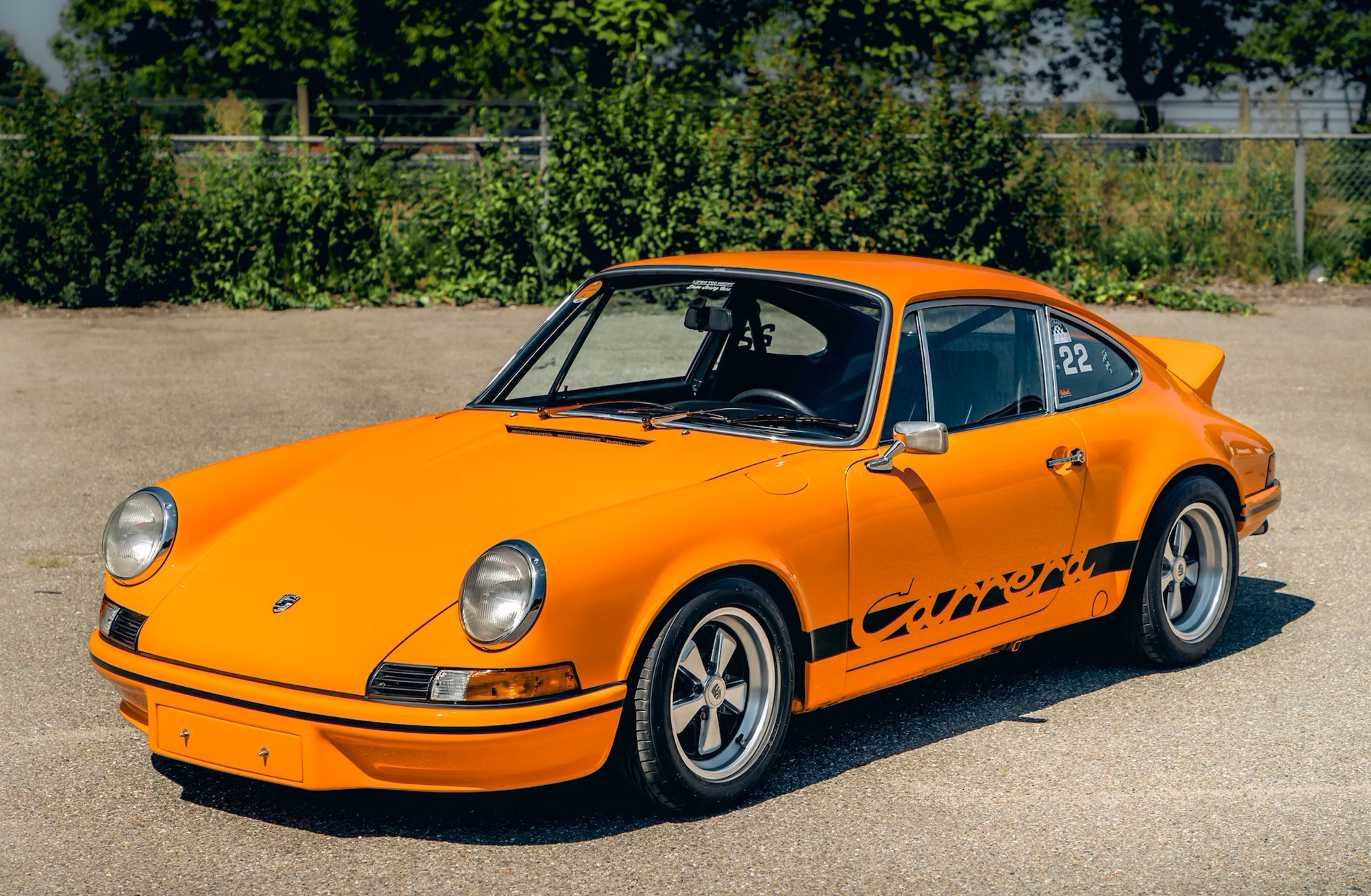
The Porsche 911 Carrera RS 2.7 is widely known today as the ducktail, the RS or simply the 2.7. Its significance remains unique: it was the fastest German production car of its day and the first production model with a front and a rear spoiler. The latter earned it the nickname ducktail. With its presentation at the Paris motor show in October 1972, Porsche set off a trend for rear spoilers on production cars.
Originally planned as a special homologation model for motorsport, only 500 cars were to be built. Peter Falk, then head of production-car test driving at Porsche, describes the development team's aim: "The 911 Carrera RS 2.7 was intended as a homologation car. It was to become a very light, fast sports car."
Demand exceeded every expectation. By the end of November 1972, all 500 planned cars were sold. Porsche increased production and, by July 1973, had built a total of 1,580 cars, which made homologation for Group 3 possible as well.
"Its repertoire: to the race under its own steam and home again. Monday to the office. Tuesday to Geneva. Back in the evening. Wednesday the shopping. Town. Traffic jams. Crawling traffic, but no sooted plugs, no clutch giving up. Thursday open roads, motorway, hairpins, gravel tracks, roadworks. Friday only short journeys and cold start after cold start. Saturday to Finland with the holiday luggage. Carrera RS, full of inexhaustible reserves in the sprint and in the marathon alike."
Porsche advertising for the 911 Carrera RS 2.7
210 PS
2.7-litre flat six at 6,300 rpm
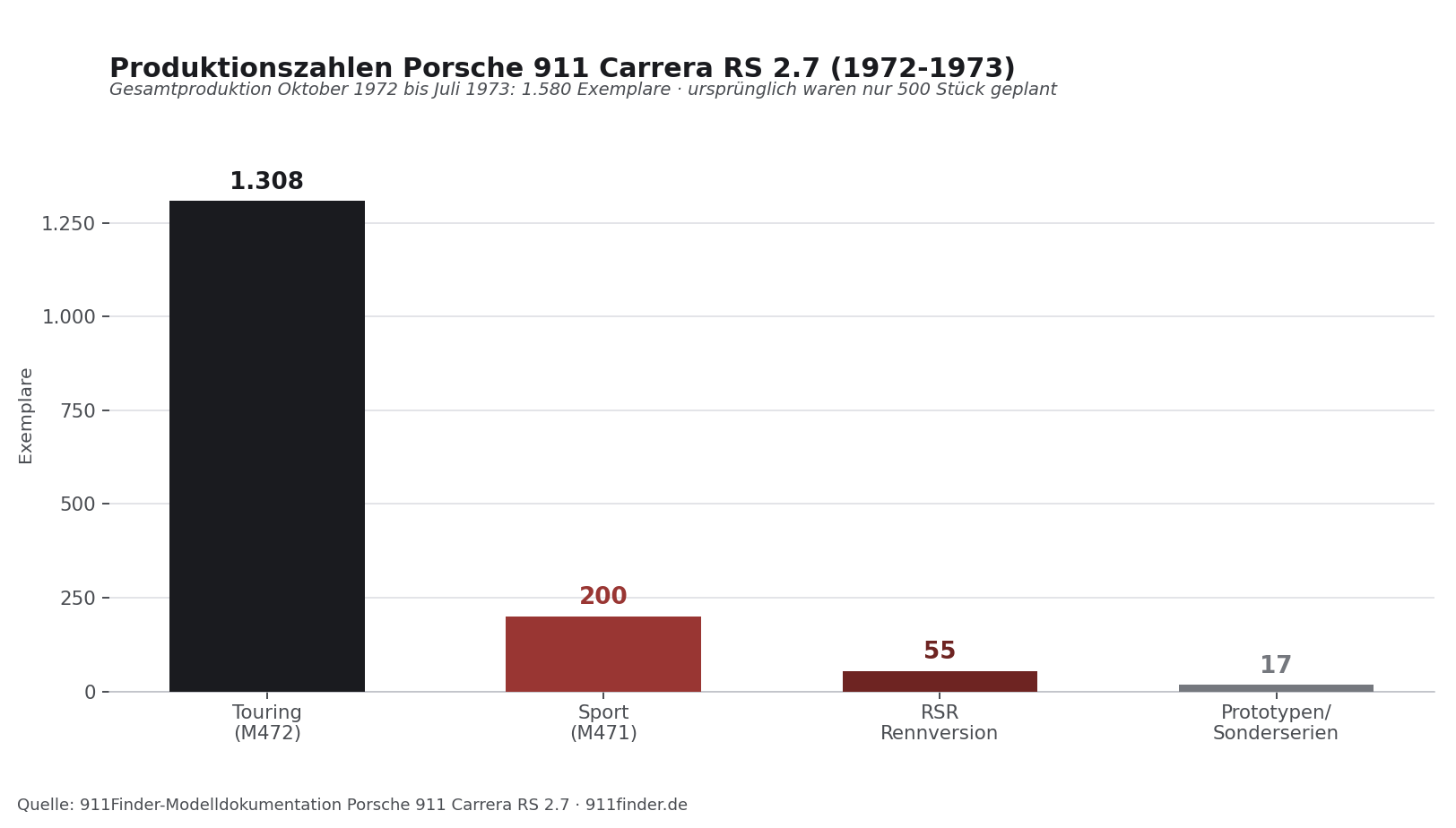
1,580
cars built
€550,000
Median sale price June 2026 (17 sales)
€620,000
Condition grade 1, Classic Data May 2026
The four variants of the Carrera RS 2.7
From Touring to prototype
1. Touring version (M472)
1,308 cars · DM 34,000 plus DM 2,500 for the M472 package (1973)
The more comfortable version of the RS 2.7
It kept many comfort features of the standard 911, including the full interior, insulation and components of normal weight
Weight around 1,075 kg, so 115 kg heavier than the Sport version, but considerably more comfortable day to day
0-100 km/h in 6.3 seconds, top speed 240 km/h
2. Sport/Lightweight (M471)
200 cars · DM 34,000 plus DM 700 for the M471 package (1973)
The most radical road version, at a kerb weight of only 960 kg
Everything superfluous removed: thin panels, thinner glass, no rear seats, no carpets, no clock, no coat hooks, no armrests
To order, two light bucket seats instead of the heavier sports seats
0-100 km/h in 5.8 seconds, top speed 245 km/h
3. RSR for motorsport
55 cars · a pure racing version
The racing version, with a considerably wider body
Around 300 PS from the 2.8-litre engine
As early as February 1973, Peter Gregg and Hurley Haywood won the Daytona 24 Hours by a margin of 22 laps
Further success at the Sebring 12 Hours and the Targa Florio
4. Prototypes and special series
17 cars · the most valuable RS models
Extremely rare cars built as development prototypes or for special purposes
Some for internal use at Porsche, others for testing and presentations
Often a particularly interesting history and individual features that set them apart from the production cars
Today the most valuable RS models; prices of more than €2m are possible
Production figures for the four variants: Touring (M472) 1,308, Sport (M471) 200, RSR 55, prototypes and special series 17, 1,580 cars in total
Technical innovations and particularities
What makes the RS 2.7 unique
The engine: power and innovation +
The fuel-injected 2.7-litre six-cylinder flat engine produced 210 PS at 6,300 rpm and 255 Nm of torque at 5,100 rpm. Those figures made the RS 2.7 Sport the first production car to break the six-second mark from 0-100 km/h (as measured by the magazine "auto, motor und sport"). The increase in displacement to 2.7 litres and the mechanical fuel injection both contributed to the gain in power.
The body: lightweight construction and aerodynamics +
The body was optimised for maximum weight reduction. Thin panels, thin glass, plastic parts and doing without insulation all helped to reduce the overall weight. At the same time the aerodynamics were improved. The aim was to minimise lift at the front and rear axles at high speed, in order to achieve more neutral handling.
The ducktail: more than a design element +
For the RS 2.7, the engineers Hermann Burst and Tilman Brodbeck, together with the stylist Rolf Wiener, developed the first rear spoiler to be tested in the wind tunnel and on test tracks. This characteristic ducktail pressed the car onto the road at higher speeds, improved the cooling of the rear-mounted engine and even raised the top speed by 4.5 km/h through reduced drag.
Hermann Burst explains: "In testing we found that a taller spoiler let us raise the top speed, because it reduced drag. So we raised the rear spoiler millimetre by millimetre with sheet metal at the trailing edge until we found the turning point at which drag began to increase again." On 5 August 1972, the three Porsche employees filed patent disclosure no. 2238704 with the German patent office.
The chassis: a pioneering tyre combination +
The engineers also worked intensively on the chassis. By that point Porsche had already gathered experience with wider rear wheels in motorsport and carried the idea over to the RS 2.7. Peter Falk recalls: "We wanted to improve traction and handling with wide tyres at the rear axle, because that is where most of the weight sits."
For the first time at Porsche, a production car received different tyre sizes front and rear: forged Fuchs wheels, 6 J × 15 with 185/70 VR-15 tyres at the front, 7 J × 15 with 215/60 VR-15 at the rear. To make this combination possible, the body was widened by 42 mm at the rear wheel arches.
The Carrera name +
The RS 2.7 was the first 911 to carry the Carrera lettering along its flanks, placed between the wheel arches. The Spanish word carrera means race, and the RS on the rear spoiler stands for Rennsport, motorsport. For Porsche, the Carrera Panamericana was the inspiration for the new name. In 1953 Porsche took its first class win in that endurance race with the 550 Spyder. In 1954 came third place overall, a sensation that prompted the use of the name.
In the years that followed, Porsche used the name Carrera for its most powerful cars, at first for models with the 1954 four-cam Fuhrmann engine, such as the 356 A 1500 GS Carrera and the 356 B 2000 GS Carrera GT. Accounts from the time also describe Carrera as a "mark of quality for a technical delicacy that has proved itself on racetracks and rally stages". In short, it was the ideal name for the future top model of the 911.
Value development and the collector market
Historical value development in detail (2011-2026)
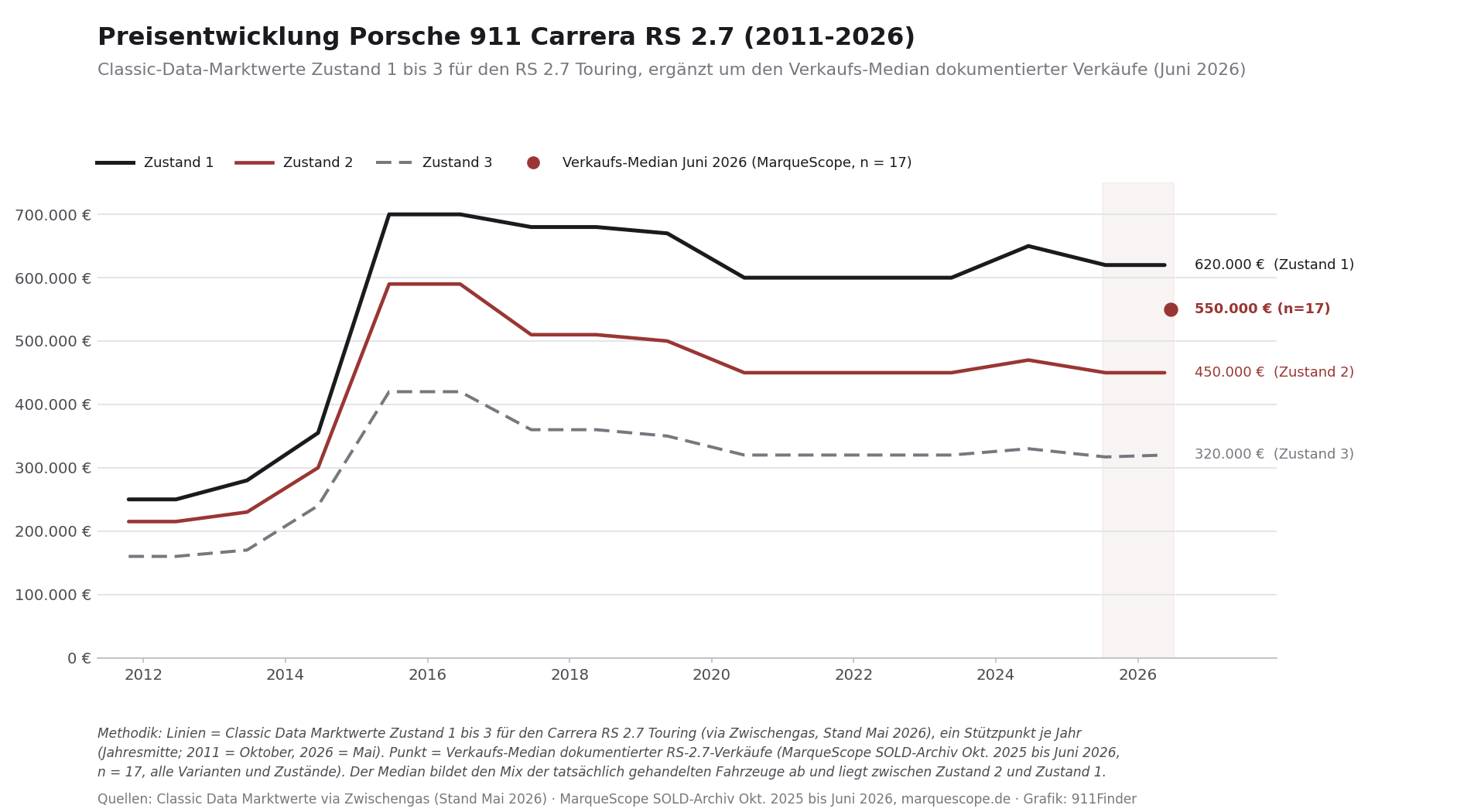
The price development of the Porsche 911 Carrera RS 2.7 Touring is an impressive example of how a piece of automotive cultural heritage grows in value. The Classic Data market values to May 2026 show a remarkable development that is relevant to collectors and investors alike. Our evaluation of the price development shows clearly distinct phases in the collector market. For the June 2026 update, the Classic Data curve is supplemented by the median sale price from the MarqueScope SOLD archive; the change of method from the condition-grade system to the median sale price is shown in the chart and in the tables.
Classic Data market values for condition grades 1 to 3 for the Carrera RS 2.7 Touring (via Zwischengas, as at May 2026), with the June 2026 median sale price of all documented RS 2.7 sales (MarqueScope)
The six market phases at a glance
Phase
Period
Condition grade 1
Condition grade 2
Condition grade 3
1. A stable starting point
2011-2013
€250,000 to €280,000
€215,000 to €230,000
€160,000 to €170,000
2. An explosive jump in price
2014-2015
€700,000 (+180%)
€590,000 (+174%)
€420,000 (+163%)
3. A high plateau and cooling
2015-2019
€700,000, then €670,000
€590,000, then €500,000
€420,000, then €350,000
4. Market correction
2019-2023
€600,000 (-10%)
€450,000 (-10%)
€320,000 (-9%)
5. A short-lived recovery
2023-2024
€650,000 (+8%)
€470,000 (+4%)
€330,000 (+3%)
6. The current tendency
2024-2026
€620,000 (-5%)
€450,000 (-4%)
€320,000 (-3%)
Phase 1 (2011-2013): In this period, prices for the Porsche 911 Carrera RS 2.7 Touring moved at a level that, in retrospect, was astonishingly low but stable: concours condition (grade 1) €250,000, very good condition (grade 2) €215,000, good condition (grade 3) €160,000. By the middle of 2013 the figures had risen moderately to €280,000, €230,000 and €170,000.
Phase 2 (2014-2015): From 2014 a historic rise in value set in that can, in retrospect, be called the most dramatic jump in price in the history of this model. Between June 2014 (€355,000 in condition grade 1) and June 2015 (€700,000), prices doubled within twelve months; against the starting point of €250,000, the value had almost tripled by the middle of 2015. This explosive growth was driven by several factors: growing recognition of the historical significance of the first Carrera RS, increased interest from international collectors and investors, and the generally growing demand for high-quality classic Porsches.
Phase 3 (2015-2019): The peak was reached in mid-2015: €700,000 in condition grade 1, €590,000 in grade 2 and €420,000 in grade 3. In grade 1 this plateau held until the start of 2017, after which the market cooled in stages: through €680,000, €510,000 and €360,000 (2017/2018) to €670,000, €500,000 and €350,000 in May 2019.
Phase 4 (2019-2023): In the summer of 2019 the quotations fell back to €600,000, €450,000 and €320,000 and stayed there for four years, until the middle of 2023. This phase coincided in part with the COVID-19 pandemic, but the market for high-quality collector's cars such as the Carrera RS 2.7 showed remarkable resilience compared with other investment and collecting classes.
Phase 5 (2023-2024): In the autumn of 2023 the market picked up again: by November 2023 the figures had risen to €650,000, €470,000 and €330,000, a gain of 3 to 8 per cent across all condition grades.
Phase 6 (2024-2026): Since the spring of 2025 the figures have eased slightly, to €620,000, €450,000 and €317,000; in May 2026 grade 3 is quoted at €320,000 again. Against the peak of 2015/2016, grades 2 and 3 are therefore around 24 per cent lower, grade 1 around 11 per cent. Market experts read this slight decline as a normal fluctuation in a mature market, not as a sign of any fundamental loss of value.
The balance over 15 years
Over the whole 15-year period under review (2011-2026), the result is a doubling to two-and-a-half-fold increase in value, depending on the condition of the car: grade 1 from €250,000 to €620,000, grade 3 from €160,000 to €320,000. The average annual return lies between 4.9% and 6.4%, clearly above the rate of inflation and comparable with other high-quality forms of investment. It is notable how much influence the condition of the car has on value development: the difference between grade 1 and grade 3 has more than tripled, from €90,000 in 2011 to €300,000 in May 2026. That underlines the growing importance of quality, originality and documentation.
Classic Data market values (2011-2026)
Condition
2011
2016
2020
Peak (year)
May 2026
Since the peak
Condition grade 1
€250,000
€700,000
€600,000
€700,000 (2015-2017)
€620,000
-11.4%
Condition grade 2
€215,000
€590,000
€450,000
€590,000 (2015/16)
€450,000
-23.7%
Condition grade 3
€160,000
€420,000
€320,000
€420,000 (2015/16)
€320,000
-23.8%
Classic Data market values for the 911 Carrera RS 2.7 Touring (via Zwischengas, as at May 2026); annual figures are mid-year, 2011 is October. The grade 1 peak of €700,000 held from mid-2015 to the start of 2017, the peaks for grades 2 and 3 (€590,000 and €420,000) from mid-2015 to mid-2016.
Market values by condition grade (as of 2025 and May 2026)
Condition
As of 2025
Classic Data (May 2026)
Description
Condition grade 1
€620,000
€620,000
Flawless condition. Technically and visually perfect, with the correct original paint and original parts
Condition grade 2
€450,000
€450,000
Good condition. Mechanically free of faults, light signs of use
Condition grade 3
€317,000
€320,000
Used condition with minor faults, roadworthy
The 2025 figures (€620,000/€450,000/€317,000, RS 2.7 Touring) correspond to the Classic Data market values from April 2025 to January 2026; in May 2026 Classic Data raised the grade 3 figure to €320,000 again, while grades 1 and 2 stayed unchanged. Reality check, June 2026: the median sale price of the documented RS 2.7 sales (€550,000, 17 sales) lies between grade 2 (€450,000) and grade 1 (€620,000) and supports this placing; the range of the sales (€390,000 to €1,100,000) reflects the wide spread in condition and originality.
Documented sales: MarqueScope market data (as at June 2026)
For the June 2026 update, 52 recorded RS listings from the MarqueScope SOLD archive were evaluated (October 2025 to June 2026). The platform labels "F-Modell Carrera RS" and "F-Modell Carrera RS 2.7" denote the same model and are merged into one cell. 27 listings carry a price; relistings of the same car (identical or near-identical mileage, sometimes across several sources) count as one sale, which leaves 21 sales. Four of those are flagged as suspected mislabels and are not included in the core row: two listings are, by their own description, G-Series Carrera 2.7 MFI cars (first registered 09/1973 and 11/1973, so after long-hood production ended in July 1973), one is a 911 with a retrofitted RS engine, and one carries a first registration of 05/1972, before series production began in October 1972. Prices correspond to the last recorded asking price of the car sold.
Cell
Sales
Median
Range
Median km
Days on market
911 Carrera RS 2.7 (plausible registration date, Touring and Sport together)
17
€550,000
€390,000 - €1,100,000
73,718
124 days
Suspected mislabels (for information, not included in the row above)
4
€137,456
€91,500 - €165,900
26,594
42 days
The Touring (M472) and Sport (M471) cannot be separated systematically from the platform data; only one sale is explicitly described in the listing as a Lightweight (€690,000). The first registrations in the core row fit the production window: 15 from 1973, two from 1972. The lowest figure in the core row (€390,000) belongs to a car with 241,000 km.
For dealers & professionals: This table is an extract. The full MarqueScope dashboard gives you active listings, the complete SOLD archive, days on market, price deltas and options scores for 8 premium marques, turning 3 hours of research into 5 minutes. Discover MarqueScope →
Motorsport separately: the Carrera 2.8 RSR. The export contains five listings with an RSR label, only one of them with a price (€249,911). Two of the five run explicitly as "modified" on the platform; the single price sits far below the level of an original 2.8 RSR (55 cars built) and is to be treated as a suspected replica or tribute. No reliable market value for original RSRs can be derived from this archive.
What the June 2026 sales data shows +
The core cell: 17 deduplicated sales with a plausible registration date, a median of €550,000 at a median mileage of 73,718 km
The lower end is explicable: €390,000 belongs to a car with 241,000 km; the upper end is marked by a sale at €1,100,000
Only one sale is explicitly listed as a Sport/Lightweight (M471): €690,000; the platform data do not support a reliable split between Touring and Sport
A median of 124 days on the market: the RS market is a market for the patient, and volume long-hood cars sell considerably faster in the same archive
Reality check against the condition grades: the median of €550,000 lies between grade 2 (€450,000) and grade 1 (€620,000), which fits a market in which mostly restored to very good cars change hands
Beware of apparent bargains: four sales between €91,500 and €165,900 turned out to be suspected mislabels (a G-Series Carrera 2.7 MFI, an RS engine conversion, a first registration before series production began); there were no genuine RS 2.7s below €200,000 in the archive
Source: MarqueScope market monitoring, export of 11 June 2026. More at marquescope.de
The Carrera RS 2.7 model bible
The complete knowledge: the Investor Dossier & Technical Compendium, in German
Detailed expert knowledge on the Porsche 911 Carrera RS 2.7: variants, production numbers, criteria for originality, market phases and price forecasts for collectors and investors.
Based on the price development of the last 15 years, and on the most recent market tendencies in particular, the following can be derived for the future: the market for the Porsche 911 Carrera RS 2.7 appears to have entered a more mature phase. The explosive growth of 2014-2015 will not repeat itself. Instead, moderate annual increases in value of 3-5% are to be expected, interrupted by short phases of consolidation.
Short-term forecast (to 2027)
Condition
Forecast to 2027
Condition grade 1
€650,000 - €680,000
Condition grade 2
€470,000 - €490,000
Condition grade 3
€330,000 - €350,000
Medium- to long-term forecast (2027-2031)
Condition
Forecast to 2031
Condition grade 1
€700,000 - €750,000
Condition grade 2
€500,000 - €550,000
Condition grade 3
€350,000 - €380,000
In the longer term, the limited numbers and the growing historical significance of the RS 2.7 will continue to support positive value development. Special examples of the Sport/Lightweight variant (M471) with a perfect history could continue to pass the million mark, while very rare prototypes and special models should continue to trade in the region of several million euros.
Reality check, June 2026: The median sale price of the 17 documented RS 2.7 sales is €550,000 (range €390,000 to €1,100,000), which puts it in the corridor between grade 2 (€450,000) and grade 1 (€620,000). The forecast bands to 2027 therefore remain plausible. At the same time, the highest documented sale (€1,100,000) and the only sale explicitly listed as a Lightweight (€690,000) confirm that the best cars and the rare variants trade clearly above the average figures. Bear the change of method in mind: median sale prices reflect the mix of cars actually traded, not a condition grade.
Conclusion
A first-class investment with cult status
Over the last 15 years the Porsche 911 Carrera RS 2.7 has established itself as a first-class investment. Despite the slight market corrections of recent times, it remains one of the most coveted collector's cars in the world of classic sports cars.
The average annual growth in value of 4.9% to 6.4% over a 15-year period clearly exceeds the rate of inflation and stands comparison with many traditional forms of investment. The resilience of the market during economically difficult times such as the financial crisis and the COVID-19 pandemic is particularly notable.
The dramatic jump in price between 2014 and 2015 was a one-off phenomenon that will probably not repeat itself in that form. Even so, the price development shows that in the long term the market for high-quality, historically significant cars such as the RS 2.7 tends steadily upwards.
The 911Finder assessment
For collectors and investors, the Porsche 911 Carrera RS 2.7 remains an attractive investment that, alongside the financial aspect, offers considerable emotional and cultural value. As one of the milestones in the history of the motor car and as the founder of a legendary model line, it will keep its place among the most significant sports cars of all time in the future too.
The condition-grade figures in this analysis are based on the Classic Data market values for the Carrera RS 2.7 Touring (via Zwischengas, as at May 2026). The sales data from June 2026 marked as such come from the MarqueScope SOLD archive (October 2025 to June 2026, deduplicated, marquescope.de). All prices are market or median values and can vary considerably by individual specification, condition and mileage.