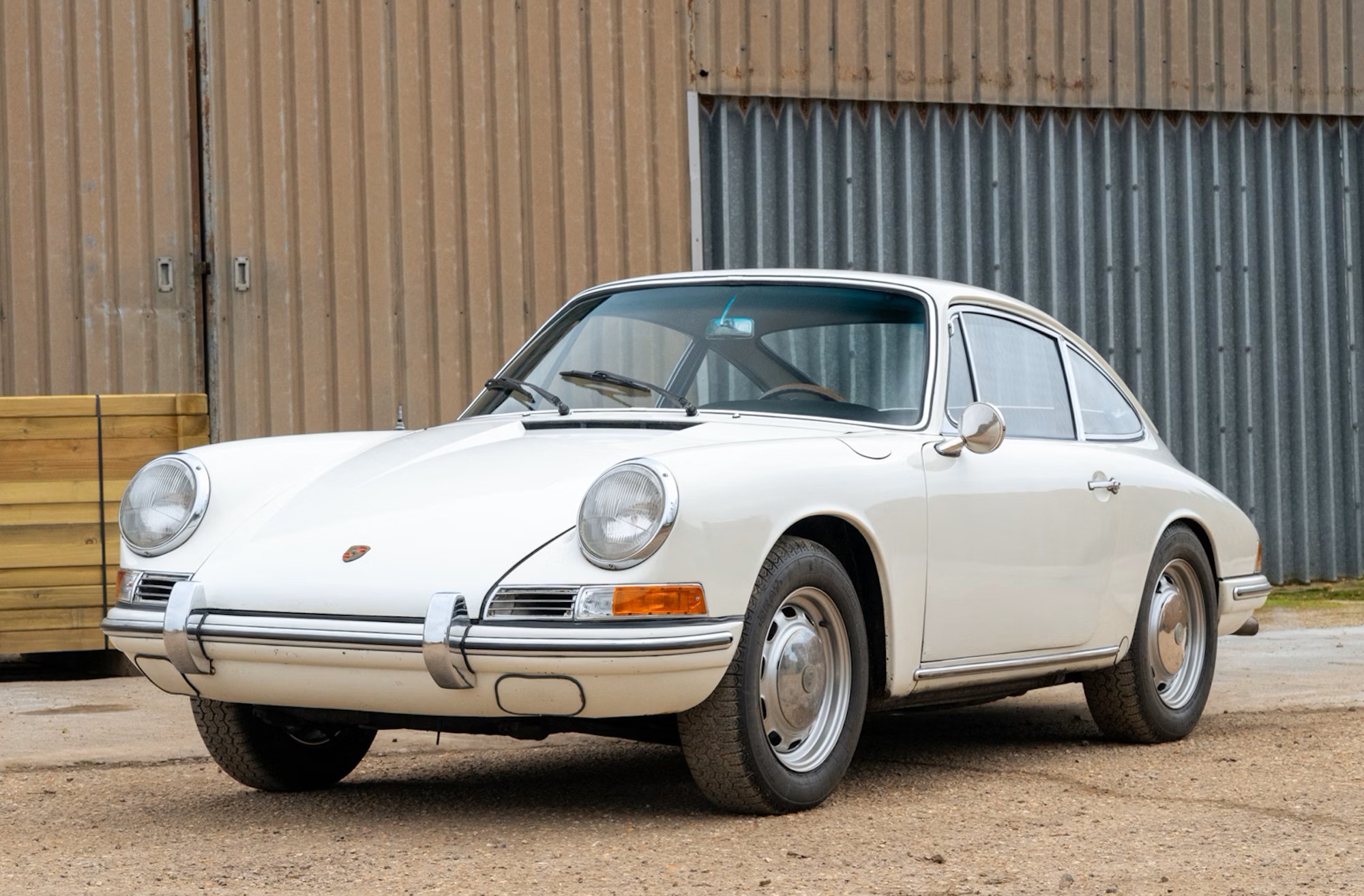
Market values for the first 911 generation (1964-1968) from 2011 to 2026: the original 911, the 912, the 911 S, L, T and Targa, with market analysis, recommendations and a forecast to 2030. For the June 2026 update the series has been rebuilt on the Classic Data market values (via Zwischengas) and supplemented by 199 documented sales from the MarqueScope SOLD archive.
This analysis examines the historical price trends of the first generation of the Porsche 911 (1964-1968) and its various model variants. Drawing on extensive data, it identifies trends, sets out where the investment potential lies and offers forecasts to 2030. The material should be of value to collectors and investors alike who take an interest in this iconic sports car.
For the June 2026 update the historical price series has been rebuilt: it is now based on the Classic Data market values (condition grades 1 to 3, via Zwischengas, as at May 2026) from October 2011 to May 2026, and has been supplemented by 199 documented sales from the MarqueScope SOLD archive (October 2025 to June 2026). Because the platform model designations for early 911s carry no engine capacity, cars are assigned to the 1st generation by their year of first registration (the 2.0-litre era, up to first registration in 1969). Market values (Classic Data, by condition grade) and median sale prices (MarqueScope) are shown separately in every table and chart.
1991 cc
flat-six
232
Original 911s built in 1964
199
documented sales in the MarqueScope archive (as at June 2026)
€245,000
Median sale price, 911 S Targa first registered 1967-68, the most expensive cell
Model specifications and distinguishing features
From the original 911 to the soft-window Targa
911 base model (1964-1968)
1,991 cc · 96 kW (130 PS)
The first 911 was originally shown as the Porsche 901 but had to be renamed because of Peugeot’s naming rights
Original price: DM 21,900 (1964)
Only 232 cars were built in 1964 before production stopped on 23 December 1964
Previous assessment (as at 2025): thanks to their rarity and historical significance, early cars reach top prices of up to €195,000
Porsche 912 (from 1965)
Flat-four · 66 kW (90 PS)
Engine from the 356
A cheaper entry model for customers who found the 911 too dear
Original price: DM 16,250 (1965)
At first it even outsold the 911
Previous assessment (as at 2025): long underrated, the 912 has gained considerably in value in recent years
911 S (from summer 1966, model year 1967)
2.0 litres, higher compression · 118 kW (160 PS)
Recognisable by its distinctive Fuchs alloy wheels
Original price: DM 24,000 (1966)
Previous assessment (as at 2025): the most valuable model of the first generation, with prices up to €275,000
911 L (model year 1968)
96 kW (130 PS) · around 1,600 cars
The "luxury" version that replaced the base model
Original price: DM 23,500 (1968)
Previous assessment (as at 2025): much sought after because of the small numbers built, with values up to €220,000
911 T (from 1968)
81 kW (110 PS)
A cheaper entry model ("Touring") with a four-speed gearbox (the other models had five)
Original price: DM 22,500 (1968)
Previous assessment (as at 2025): long underrated, T models have gained strongly in value in recent years
911 Targa (from model year 1967)
The open variant · roughly DM 3,000 extra
The open version with its broad roll-over bar, removable roof panels and, at first, a folding rear section with a plastic window (the "soft window")
Previous assessment (as at 2025): the early "soft window" cars in particular are much sought after and were then thought to reach prices of up to €250,000
Reality check, June 2026
Since mid-2023 the market trend has been downwards: depending on the 911 variant, the Classic Data market values for condition grade 2 in May 2026 sit roughly 14 to 16.5 per cent below the interim high of May 2023. Even so, the median sale prices of the documented June 2026 sales are frequently at or above the condition-grade-1 market value: 911 with no variant label €164,950 (Classic Data condition grade 1: €156,000, grade 2: €118,000), 911 S Coupé first registered 1966-68 €169,945 (grade 1: €164,000), 911 E Coupé €113,950 (grade 1: €105,000); the 911 T Coupé at €99,911 sits between grade 2 (€86,600) and grade 1 (€118,000). None of this contradicts the falling market: the SOLD archive is dominated by prepared, ready-to-sell dealer cars whose final prices sit at the top of the condition scale. The 911 S 2.0 Targa of the soft-window era (first registered 1967-68) achieved a median of €245,000 (8 sales, top price €350,000), markedly more than the grade-1 value of the 911 S Targa 1966-68 (€159,000). The 911 L stayed between grade 2 (€91,000) and grade 1 (€125,000) at a €119,000 median (7 sales). Every cell and median is set out in the price trends section.
How the market moved up to June 2026
Price trends over time
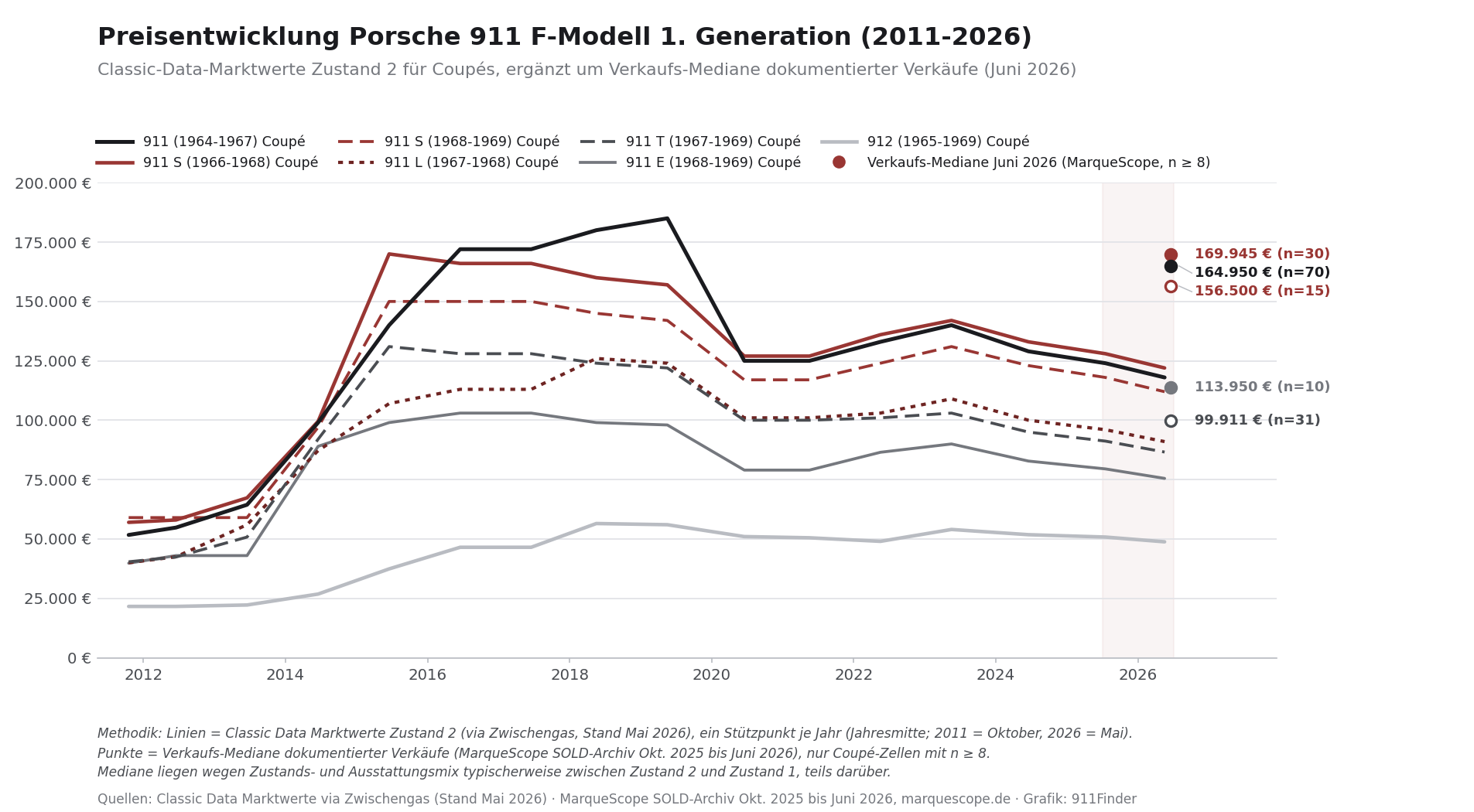
Classic Data market values at condition grade 2 for the Coupé variants (via Zwischengas, as at May 2026), October 2011 to May 2026, supplemented by the median sale prices of documented sales from the MarqueScope SOLD archive (June 2026, Coupé cells with at least 8 sales)
The most important market phases +
A stable base from 2011 to 2013: grade-2 values move sideways to moderately upwards (911 Coupé: from €51,700 in October 2011 to €64,400 by mid-2013)
The boom from 2013 to 2015/16: the steepest rise in the whole series. Between mid-2013 and mid-2015 the grade-2 values of most 911 variants double (911 Coupé: €64,400 to €140,000, 911 T Coupé: €50,800 to €131,000); the S and T models reach their all-time highs as early as 2015/16
A plateau with a widening spread from 2016 to 2019: the 911 S, T and E ease back slightly from their boom highs, while the base model (peak: €185,000 in 2019), the 911 L and the 912 continue to climb into 2018/19
A sharp correction in 2020: between the November 2019 and June 2020 tables, Classic Data cuts its valuations by roughly 17 to 32 per cent (911 Coupé at grade 2: from €185,000 to €125,000), while the 912 range loses only around 4 to 9 per cent; 2020/21 runs sideways
A moderate recovery from 2022 to May 2023: 3 to 17 per cent up from the 2021 level to the interim high in May 2023 (911 Coupé: €140,000), which remains well below the all-time highs of 2015 to 2019
A falling market since mid-2023: by May 2026 the 911 variants have lost roughly 14 to 16.5 per cent at grade 2 (911 Coupé: €140,000 to €118,000); the 912 range holds up better at minus 4 to minus 10 per cent
June 2026: the median sale prices of the documented sales sit above the grade-2 market values and in places above grade 1; that reflects prepared dealer cars in top condition and does not contradict the falling market trend
Classic Data market values, condition grade 2 (2011-2026)
Market values for cars at condition grade 2 (very good, fault-free) from the Classic Data price tables, retrieved via Zwischengas (as at May 2026). One data point is given per year, at mid-year (2011: October, 2025: July, 2026: May). "Peak" means the highest annual data point in the series since October 2011.
Model
2011
2016
2020
Peak (year)
May 2026
since the peak
911 (1964-1967) Coupé
€51,700
€172,000
€125,000
€185,000 (2019)
€118,000
-36.2%
911 S (1966-1968) Coupé
€57,000
€166,000
€127,000
€170,000 (2015)
€122,000
-28.2%
911 S (1966-1968) Targa
€56,000
€161,000
€125,000
€161,000 (2016/17)
€118,000
-26.7%
911 S (1968-1969) Coupé
€59,000
€150,000
€117,000
€150,000 (2015-2017)
€112,000
-25.3%
911 S (1968-1969) Targa
€58,000
€145,000
€112,500
€145,000 (2016/17)
€107,000
-26.2%
911 L (1967-1968) Coupé
€40,000
€113,000
€101,000
€126,000 (2018)
€91,000
-27.8%
911 L (1967-1968) Targa
€42,300
€110,000
€99,000
€140,000 (2015)
€88,400
-36.9%
911 T (1967-1969) Coupé
€40,400
€128,000
€100,000
€131,000 (2015)
€86,600
-33.9%
911 T (1967-1969) Targa
€42,000
€124,000
€95,500
€125,000 (2015)
€82,100
-34.3%
911 E (1968-1969) Coupé
€39,800
€103,000
€79,000
€103,000 (2016/17)
€75,500
-26.7%
911 E (1968-1969) Targa
€42,000
€100,000
€75,500
€100,000 (2016/17)
€73,900
-26.1%
912 (1965-1969) Coupé
€21,600
€46,500
€51,000
€56,500 (2018)
€48,800
-13.6%
912 (1965-1969) Targa
€22,000
€49,000
€53,000
€58,000 (2018)
€49,800
-14.1%
912 E (1975-1976) Coupé
€19,200
€35,800
€35,500
€38,000 (2023/24)
€36,500
-3.9%
Source: Classic Data market values (condition grade 2) from the tabulated price series, retrieved via Zwischengas, as at May 2026; annual data points selected by 911Finder. The striking peak for the 911 L Targa in 2015 (€140,000) appears exactly so in the Classic Data tables from June to December 2015 and was cut back sharply by Classic Data in early 2016 (March 2016: €110,000). For the 911 Coupé, Classic Data raised the grade-2 and grade-3 values noticeably between November 2017 and February 2018 (€172,000 to €180,000 and €115,000 to €150,000 respectively) before the sharp correction came in early 2020.
For the 912 (1965-1969) and the US-only 912 E (1975-1976) the June 2026 update has no documented sales: the Porsche 912 is not included in the underlying 911 export from the MarqueScope SOLD archive. Both are therefore shown through the Classic Data market values alone (the rows above; the 912 additionally with the April 2025 figures in the table further down). One point stands out: the 912 range has come through the correction since 2023 far more gently than the 911 variants. As a model of 1975-1976 the 912 E belongs chronologically to the G-Series and is listed here for reference only; it does not appear in the line chart.
Documented sales: MarqueScope market data (as at June 2026)
199 documented sales with a first registration year up to 1969, from the MarqueScope SOLD archive (October 2025 to June 2026). Of the 786 rows in the export, 606 carried a sale price, and of those 205 had a first registration year up to 1969; repeat and cross-platform listings of the same car (identical registration year and identical mileage with no more than 5% difference in price, or an identical VIN) were counted as one sale each, leaving 199. The 911 S cells are split by first registration up to 1968 and first registration in 1969. Prices are the last recorded asking price of the car that sold.
Model
First registration years
Sales
Median
Range
Median km
Days on market
911 S 2.0 Targa
1967-1968
8
€245,000
€122,500 - €350,000
6,500
8 days
911 S 2.0 Coupé
1966-1968
30
€169,945
€87,500 - €359,911
15,000
26 days
911 with no variant label
1964-1968
70
€164,950
€59,900 - €849,900
10,180
144 days
911 S 2.0 Coupé
1969
15
€156,500
€99,911 - €3,500,000
16,835
8 days
911 Targa with no variant label
1967-1968
5
€149,900
€129,900 - €378,980
4,166
9 days
911 E 2.0 Targa
1968-1969
3
€139,900
€79,911 - €197,500
9,664
162 days
911 S 2.0 Targa
1969
5
€129,500
€119,900 - €165,000
25,700
8 days
911 L
1968
7
€119,000
€89,890 - €147,000
10,800
135 days
911 T 2.0 Targa
1967-1969
10
€118,250
€35,900 - €239,000
54,794
64 days
911 E 2.0 Coupé
1968-1969
10
€113,950
€69,900 - €248,929
44,488
112 days
911 T 2.0 Coupé
1967-1969
31
€99,911
€32,450 - €189,000
20,000
49 days
Not shown separately (n<3): the 911 (base) with 2 sales (median €95,000), the 911 L Targa with 2 sales, and the 911 ST (first registered 1969, €92,000, a single sale). The exotic 911 R and 911 T/R appear in the archive only without a recorded sale price, and an "outlaw" conversion (given as first registered 1977) belongs to neither generation. The Porsche 912 is not included in the underlying 911 export. US versions do not form a row of their own: every sale listed as a US model carries a first registration of 1972-73 and belongs to the oil-flap report. Some of the range maxima (€3,500,000 for a 911 S first registered 1969, and €849,900 and €378,980 in the catch-all cells) go back to special cars or to quirks in how they were recorded and do not affect the medians; several records with an identical price of €350,000 and a placeholder mileage were merged where registration year, mileage and price matched. Sportomatic: 7 sales carry the Sportomatic marking, spread across several cells; no transmission cell reaches 3 sales.
For dealers & professionals: This table is an extract. The full MarqueScope dashboard gives you active listings, the complete SOLD archive, days on market, price deltas and options scores for 8 premium marques, turning 3 hours of research into 5 minutes. Discover MarqueScope →
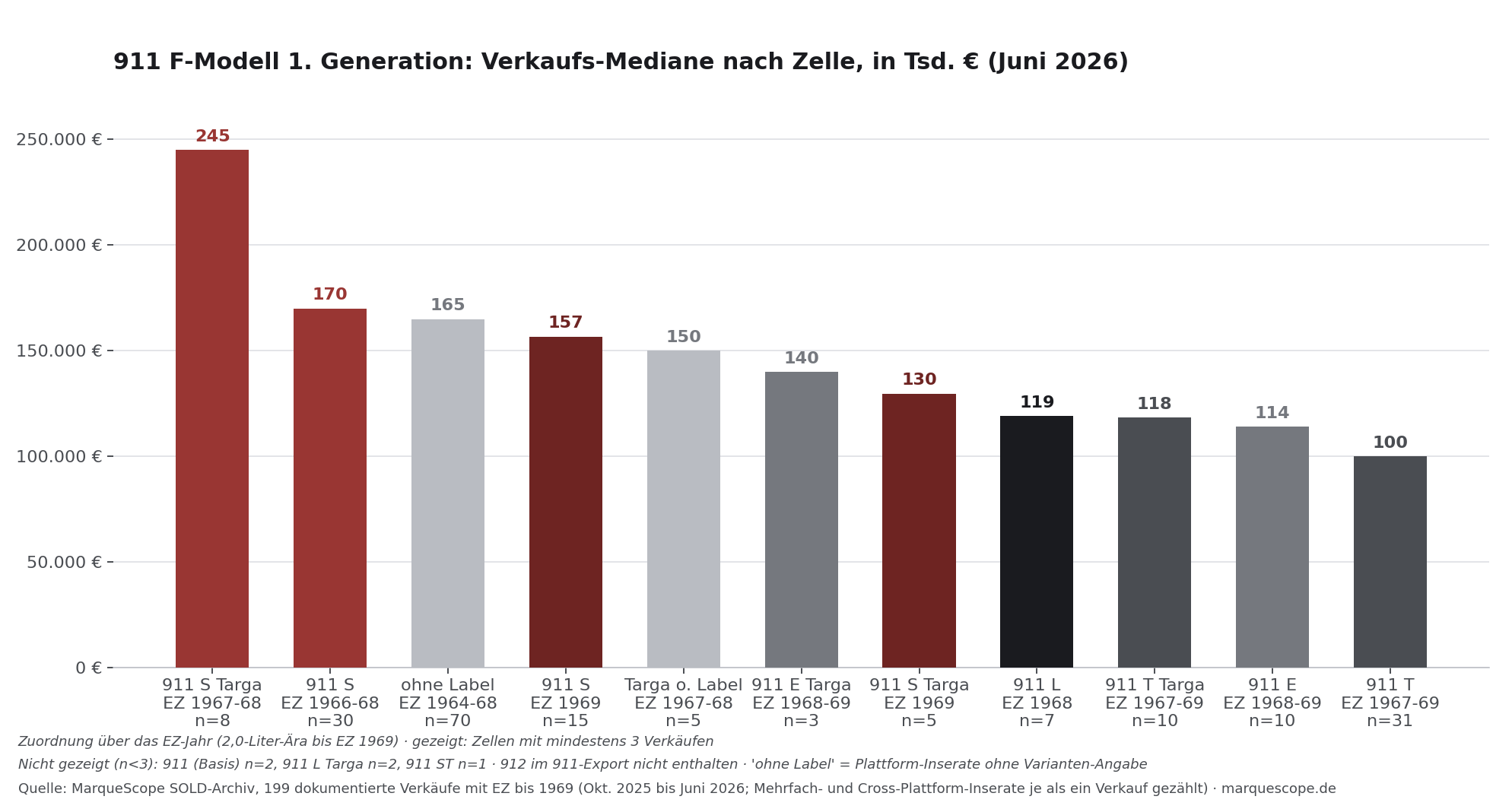
Median sale prices by cell (June 2026), assigned by year of first registration, cells with at least 3 sales
What the June 2026 sales data shows +
The soft-window era leads: at a €245,000 median (8 sales, median mileage only 6,500 km) the 911 S 2.0 Targa first registered 1967-68 is the most expensive cell of the 1st generation
On the S, the registration year makes the difference: the 911 S Coupé first registered 1966-68 achieves a €169,945 median (n=30), the 1969 cell €156,500 (n=15)
The largest cell carries no variant label (70 sales, €164,950 median): listings for early 911s often name no variant, and the range from €59,900 to €849,900 shows how mixed this catch-all cell is
Targa above Coupé: the 911 T 2.0 Targa (€118,250) and the 911 E 2.0 Targa (€139,900, only 3 sales) sit above their respective Coupé cells (€99,911 and €113,950), though on small sample sizes
Time on the market varies enormously: three of the four S cells sell in a median of 8 days (911 S Coupé first registered 1966-68: 26 days), while the catch-all cell with no variant label takes 144 days
With 31 sales the 911 T 2.0 Coupé is the largest variant cell and, at a €99,911 median, the cheapest reliable way into the 1st generation
Source: MarqueScope market monitoring, export of 11 June 2026. More at marquescope.de
Earlier 911Finder market values by condition grade (as at April 2025)
Model
Average price
Condition grade 1
Condition grade 2
Condition grade 3
Condition grade 4
Condition grade 5
911 (1964-1967) Coupé
€111,730
€164,000
€124,000
€90,200
€62,700
€40,000
911 (1966-1967) Targa
€157,010
€218,000
€167,000
€141,000
€94,100
€59,000
911 S (1966-1968) Coupé
€115,320
€173,000
€128,000
€92,200
€63,600
€41,000
911 S (1966-1968) Targa
€110,950
€167,000
€124,000
€88,300
€57,600
€37,000
911 S (1968-1969) Coupé
€104,880
€159,000
€118,000
€82,600
€52,000
€34,000
911 S (1968-1969) Targa
€100,940
€155,000
€113,000
€79,700
€50,300
€33,000
911 L (1967-1968) Coupé
€85,630
€132,000
€96,000
€67,500
€41,800
€27,000
911 L (1967-1968) Targa
€82,680
€127,000
€93,100
€64,700
€40,200
€26,000
911 T (1967-1969) Coupé
€81,030
€124,000
€91,200
€63,600
€39,500
€26,000
911 T (1967-1969) Targa
€76,660
€116,000
€86,400
€60,400
€37,400
€24,000
911 E (1968-1969) Coupé
€71,060
€111,000
€79,500
€55,800
€34,700
€22,000
912 (1965-1969) Coupé
€45,030
€70,600
€50,800
€35,300
€19,800
€12,400
912 (1965-1969) Targa
€46,040
€71,900
€51,800
€36,300
€20,600
€12,100
Figures from the earlier 911Finder analysis (as at April 2025), taken from this page’s previous market-value table; the same data lay behind the earlier chart "Price ranges for the Porsche 911/912 long-hood by condition (April 2025)". Condition grade 1 = concours condition, through to grade 5 = in need of restoration. The model split and the years given follow that earlier table. Where the models also appear in the new Classic Data table above, those condition values match the Classic Data tables from April to October 2025. The gap to the June 2026 median sale prices reflects not only the market but also the change of method, from a market value per condition grade to a median sale price.
Market analysis
The market for classic first-generation Porsche 911s has been correcting since mid-2023: depending on the variant, the Classic Data market values at condition grade 2 in May 2026 sit roughly 14 to 16.5 per cent below the interim high of May 2023 and 25 to 37 per cent below the all-time highs of 2015 to 2019. The 912 range holds up better, at roughly 4 to 14 per cent below its own peaks. At the same time the documented sales of June 2026 show that prepared cars in top condition still achieve prices at or above grade-1 level: the market discriminates sharply by quality, originality and history.
Trend: differentiation by quality +
The market draws an ever sharper line between average cars and excellent ones. Restoration projects and cars with faults are the first to give way in a falling market, while the best examples hold their value far better: the June 2026 medians for prepared dealer cars sit in places above the Classic Data grade-1 value.
Trend: the weight of originality +
Unmolested cars in original condition (matching numbers, original colour, original equipment) are particularly sought after.
Trend: demand for special series and rare variants +
Early 911 S models, soft-window Targas and cars built in small numbers (the 911 L, for instance) are where collectors are looking.
Trend: the market going international +
Demand is global, which supports prices.
Recommended actions
Recommendations for buyers
For investors
Focus on originality and documentation: Look for cars with matching numbers (chassis and engine numbers that correspond), original colours and a complete history.
Rarity as a factor in value: Look for rare specifications, early production numbers or unusual equipment, which offer the potential for above-average appreciation.
A professional inspection: Always have a thorough inspection carried out by a Porsche specialist before you buy, because hidden faults can drive restoration costs up considerably.
Assess the quality of the restoration: On a car that has already been restored, the quality of that work is decisive. There should be plenty of photographs and detailed documentation of the restoration.
For enthusiasts
Start with a 912 or a 911 T: As a way into the world of early Porsches, the 912 and the 911 T offer good value, because they deliver the authentic driving experience at a lower entry price.
Think about usability: Alongside collector value, consider how usable the car is in practice. For regular use the later years (1967-1969), with their improved engineering and ergonomics, can be the better choice.
Join a Porsche club: Joining a Porsche club gives you access to expertise, to parts and to private sales that never reach the open market.
Check parts availability: Although Porsche Classic supplies parts exceptionally well, some specific first-generation items are rare and expensive. Establish the availability of the critical components before you buy.
Buying recommendation by budget
Budget
Recommended
Reasoning
up to €60,000
912 Coupé or Targa
The way into the early Porsche world; Classic Data market value at grade 2 in May 2026: €48,800 (Coupé) and €49,800 (Targa); not included in the June 2026 911 export
€60,000-€105,000
911 T 2.0 Coupé (1967-1969)
The largest variant cell of the generation, June 2026 median sale price: €99,911 (31 sales)
€105,000-€125,000
911 E 2.0 Coupé or 911 L
June 2026 median sale prices: €113,950 (n=10) and €119,000 (n=7); the L was built in only one model year, to the tune of roughly 1,600 cars
€125,000-€160,000
911 S 2.0 Coupé (first registered 1969)
June 2026 median sale price: €156,500 (n=15); the top engine at a lower price than the earlier years
€160,000-€200,000
911 S 2.0 Coupé (first registered 1966-68)
June 2026 median sale price: €169,945 (n=30); the most sought-after closed variant of the early years
over €200,000
911 S 2.0 Targa (first registered 1967-68)
The soft-window era, June 2026 median sale price: €245,000 (n=8), the most expensive documented cell of the 1st generation
The budget bands follow the median sale prices from the MarqueScope SOLD archive (June 2026); individual cars can sit well below or above them depending on condition, history and originality.
The original 911 model bible
The complete knowledge: the Investor Dossier & Technical Compendium, in German
Detailed expert knowledge on the first 911 generation (1964-1968): model variants, production figures, criteria for originality, market data and price forecasts.
Since mid-2023 the Classic Data series have shown a correction running at roughly 5 per cent a year on average across the 911 variants; up to the May 2026 tables there is no sign of a floor. In the short term a continuation of the consolidation looks more likely than new highs, and the all-time highs of 2015 to 2019 remain out of reach for now. Over the medium term the limited numbers built, the historical significance of the original 911 and the speed at which the best cars sell (three of the four S cells: a median of 8 days on the market) all argue that quality will win out: cars with originality, an unbroken history and top condition should perform markedly better than the average. The Porsche 911 remains an icon, and the fascination of the original cars will draw in future generations of collectors and enthusiasts too.
Factors influencing the market to 2030
A generational shift among collectors +
Younger collectors entering the market could raise demand for mechanically simpler, usable classics such as the 912 and the 911 T.
Electric mobility +
Growing electrification in the new-car market could further sharpen interest in purist, analogue sports cars with combustion engines.
Regulatory developments +
Possible restrictions on combustion-engined cars in city centres could affect the market, though exemptions for historic vehicles are to be expected.
Restoration costs +
Rising costs for skilled labour and original parts will lift the value of already perfectly restored cars by more than the average.
Conclusion
Maturity, differentiation, potential for value
The market for these early Porsches shows a remarkable maturity and discrimination, rewarding not only general collector appeal but also subtle differences in model variant, originality and condition. The early Targa variants and the sportier S models in particular have proved to have above-average potential.
For investors the segment continues to offer attractive prospects, though concentrating on absolute top quality, unbroken documentation and exceptional originality will be decisive for above-average returns. Enthusiasts who put driving enjoyment first can still share in the myth of the early Porsche era at comparatively modest entry prices, with cars such as the 912 or the 911 T.
The 911Finder assessment
Financial considerations aside, the early 911s remain timeless design icons and demanding sports cars to drive, offering an incomparable link between historical heritage and dynamic experience. They represent an era of car-making in which technical refinement, aesthetic elegance and a purist driving experience came together perfectly: qualities that will secure their place as sought-after collectors’ items and stores of value in the future too.
The data used in this analysis is based on market observation, sales statistics and expert assessment from a range of sources. The historical market-value series from 2011 to 2026 come from the Classic Data price tables (condition grades 1 to 3, retrieved via Zwischengas, as at May 2026). The sales data from June 2026 that is marked as such comes from the MarqueScope SOLD archive (October 2025 to June 2026, repeat listings merged, marquescope.de). All prices can vary considerably depending on a car’s specification, condition and mileage.