996 Carrera (C2)
The base model · rear-wheel drive
- Available as a Coupé and a cabriolet
- MK1 with 300 PS, MK2 with 320 PS
- High production numbers: the model you meet most often on the used market
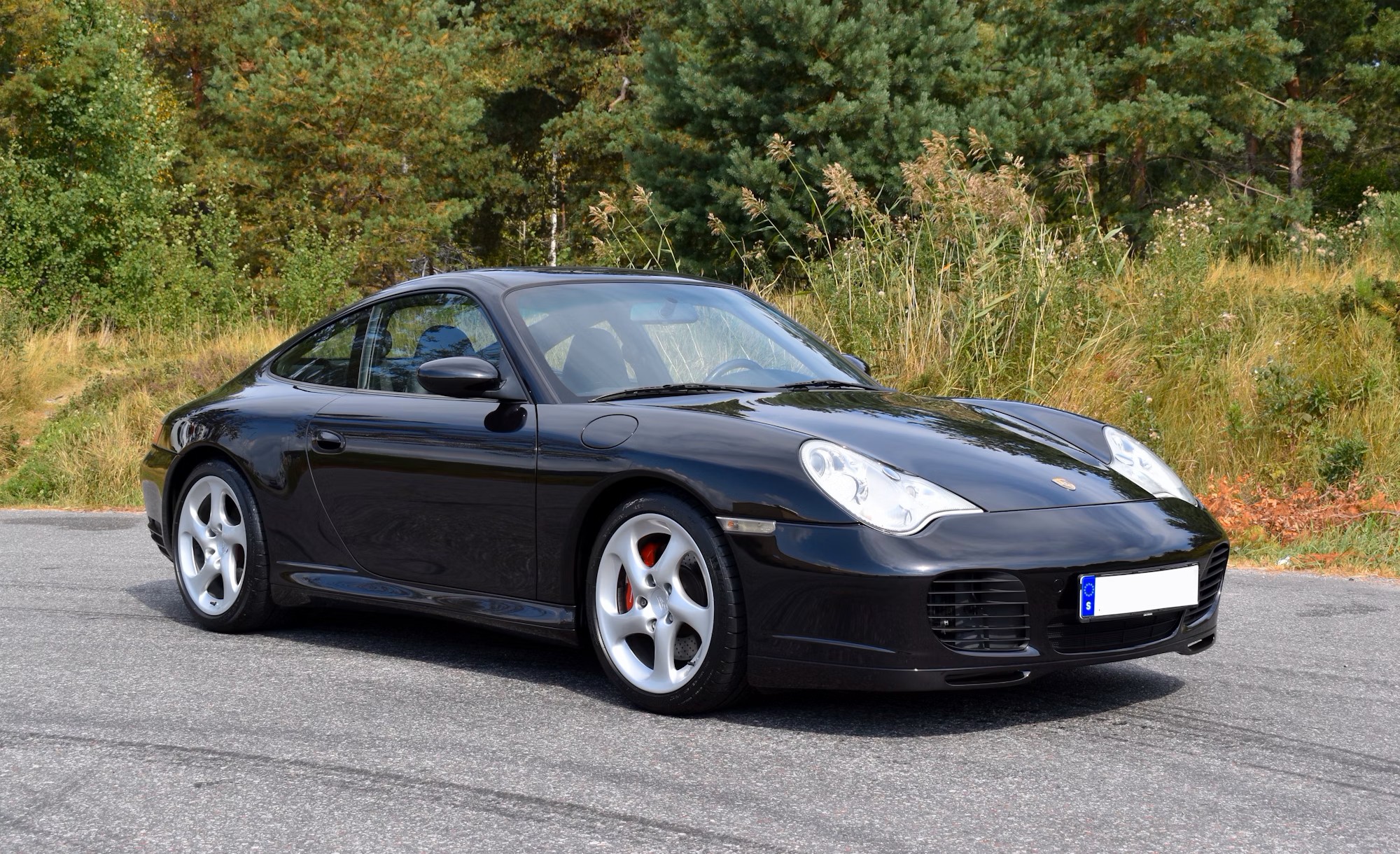
Home/Buyer's Guides/996 Carrera & Carrera S
The turning point · 1998-2006Revolution and value for money: model history, typical weak points (IMS, bore scoring), servicing costs and buying criteria. Compact and practical for your 996.
The Porsche 911 of the 996 series marks a profound turning point in the history of the legendary sports car. As the first 911 with a water-cooled engine it broke with a 35-year tradition of air cooling in 1998 and replaced the much-loved 993. That revolutionary change, together with the new design and its characteristic "fried egg" headlights, at first caused controversy among Porsche enthusiasts.
Today the 996 is increasingly recognised as an important milestone in the evolution of the 911. It combines modern engineering with the classic 911 feel and offers outstanding value for money on the used market. This buyer's guide gives a detailed overview of the various Carrera models, their technical particularities, the known weak points and valuable tips for buying a 996 successfully.
MK1: 3.4 litres, 350 Nm
MK2: 3.6 litres, 370 Nm
Rated engine speed of both units
The first water-cooled flat six
The 996 was built from 1998 to 2006 and in that time went through a significant facelift, which divides the cars into the MK1 (Mark 1, 1998-2001) and the MK2 (Mark 2, 2002-2006).
| Feature | MK1 (1998-2001) | MK2 (2002-2006) |
|---|---|---|
| Engine | 3.4 litres (M96.01) | 3.6 litres (M96.03) |
| Power | 300 PS (221 kW) | 320 PS (235 kW) |
| Headlights | The "fried egg" design with yellow indicators | Clear-lens headlights with integrated indicators |
| Cockpit | The original 996 interior | A revised centre console, a new steering wheel from the 997 |
| Transmission | 5-speed Tiptronic or 6-speed manual | 5-speed Tiptronic S or 6-speed manual with improved shift precision |
| IMS bearing | A larger diameter (dual-row), somewhat more reliable | A smaller bearing (single-row), a higher failure rate |
| Electronics | PCM 1 (where fitted) | PCM 2 with a larger display and more functions |
| Cup holder | None | Folds out of the dashboard |
| Suspension | Standard damping | Optionally with PASM (standard on the 4S) |
The facelift to the MK2 brought technical improvements alongside the visual changes: the larger 3.6-litre engine offers noticeably more power and more torque in the mid range, and the revised interior feels better made and more ergonomic. Paradoxically, though, the revised IMS bearing in the MK2 is regarded as more prone to failure than the earlier version in the MK1.
The base model · rear-wheel drive
The all-wheel-drive variant
The most coveted variant
The rare alternative
The M96 engine family marked a revolution, but it carries specific risks.
The M96 engine family: The water-cooled flat six marked a technical revolution at Porsche. It was a complete fresh start and shared no components with the air-cooled engines that came before. With an aluminium crankcase, four valves per cylinder, variable valve timing (VarioCam) and chain-driven camshafts, it was technically up to date.
3.4-litre engine (MK1, M96.01): 300 PS (221 kW) at 6,800 rpm, 350 Nm of torque.
3.6-litre engine (MK2, M96.03): 320 PS (235 kW) at 6,800 rpm, 370 Nm of torque.
IMS bearing (intermediate shaft bearing): The best-known weak point of the 996 is the intermediate shaft bearing (IMS). This ball bearing supports the intermediate shaft, which connects the crankshaft to the camshafts. A failure leads to catastrophic engine damage.
A serious problem that affects above all the 3.6-litre and 3.8-litre engines. Scoring forms on the cylinder walls, usually on bank 2 (cylinders 4-6). The causes are complex: thermal load, insufficient lubrication and the properties of the materials.
250 to 600 pages of expert knowledge (depending on the edition) as a model-specific basis for your decision on the car you want: detailed weak points, engine codes, specification details, inspection checklists, production figures, value-enhancing options and price forecasts.
Running a 996 is affordable compared with newer models, but considerably more expensive than an ordinary car.
| Item | Approximate cost (€) | Interval / note |
|---|---|---|
| Minor service | 500 - 800 | annually / every 15,000 km |
| Major service | 1,200 - 1,800 | every 60,000 km |
| Brake pads (set) | 400 - 600 | as required (around 30,000-50,000 km) |
| Brake discs + pads | 1,200 - 2,000 | as required (around 60,000-80,000 km) |
| Clutch (complete) | 1,800 - 2,500 | around 80,000 km |
| Water pump | 600 - 900 | as a precaution at 80,000-100,000 km |
| IMS bearing replacement | 1,500 - 2,500 | as a precaution, if not already done |
| Fuel costs | 1,800 - 2,400 a year | at 10,000 km (12-15 l/100 km) |
| Insurance (fully comprehensive) | 800 - 1,500 a year | annually |
| Repair | Approx. cost |
|---|---|
| Engine rebuild after IMS failure | €10,000 - €20,000 |
| Overhaul for cylinder bore damage (bore scoring) | €10,000 - €15,000 |
| Replacement gearbox | €4,000 - €6,000 |
| Air conditioning, complete | €1,500 - €2,500 |
| Targa roof mechanism | €2,000 - €4,000 |
These factors decide the value of a 996 Carrera.
The Porsche 996 Carrera has passed the test of time. The known weak points can be managed with preventive measures. For newcomers: A well-serviced MK1 (3.4 litres) is the ideal way in. For enthusiasts: The Carrera 4S (MK2) is the most coveted variant and holds its value best.
The listing, the paperwork and the price checked against real market data before you travel to view the car. A PDF dossier, usually within 24 h.
€199 incl. VAT · fixed price Assessment Level 2 · remoteDigital Audit plus follow-up questions, dealer answers, paperwork and a negotiating strategy, through to a clear buying decision.
€499 incl. VAT · audit included Assessment Level 3 · on siteA physical assessment where the car is: paint measurement, diagnostic readout, technical check, test drive and a negotiation brief.
from €790 incl. VAT · plus travelDo you already own a 911 from this model series? The Vehicle Documentation & Market Valuation puts the history, the paperwork and the market value of your car in order (€249 incl. VAT). Still looking? Then the right route is the Sourcing Enquire and name the model: Request a Digital Audit for a car from this model series.