911 Turbo
520 PS · 660 Nm
- Even the "base" car accelerates to 100 km/h in 3.2 seconds (with Sport Chrono)
- Ideal for drivers who prefer five-bolt wheels (easier wheel changes)
- Ceramic brakes are not needed in everyday use
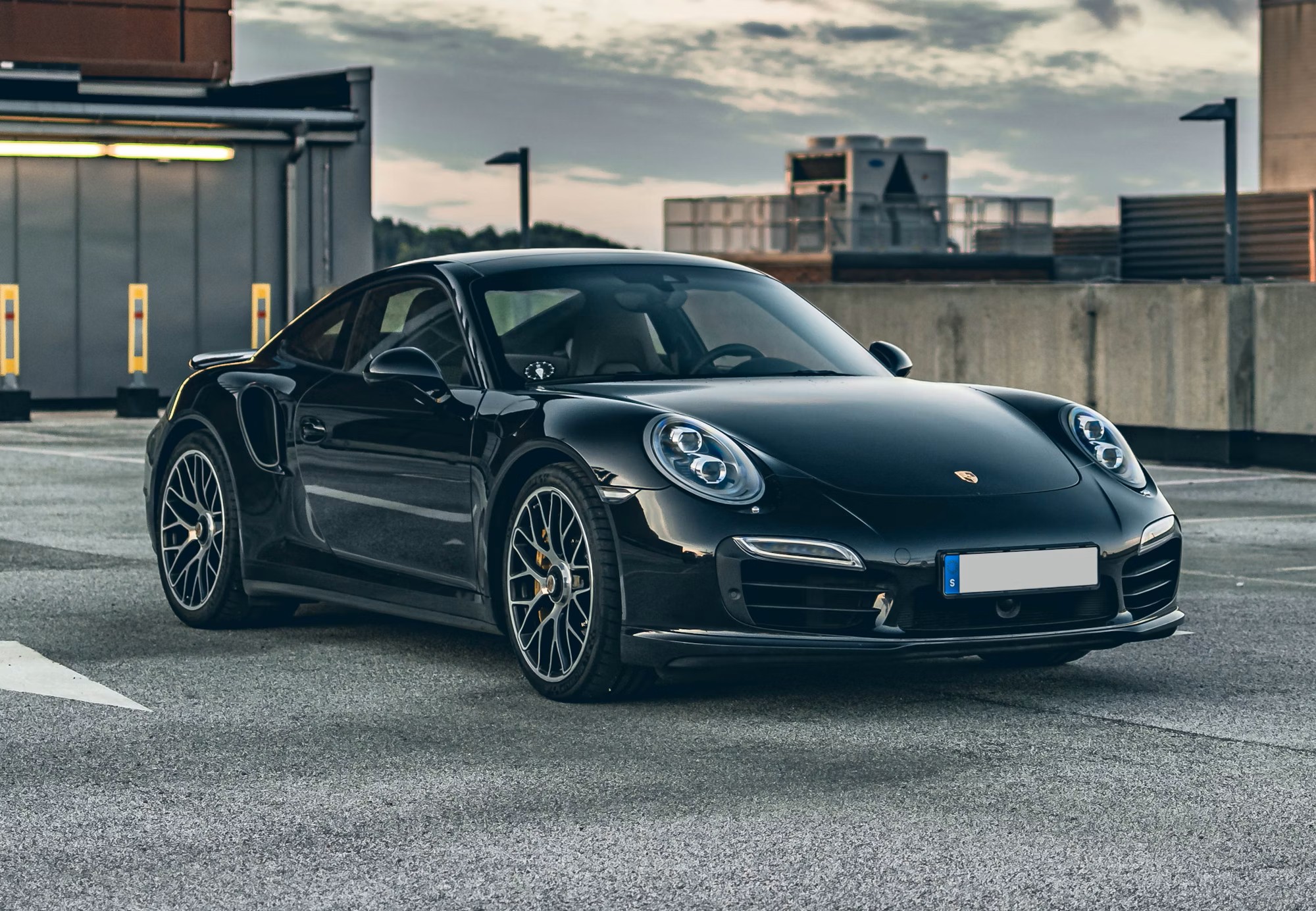
Home/Buyer's Guides/991.1 Turbo & Turbo S
The technology carrier · 2013-2016The definition of composure: weak points, checklist and price picture. So you can check condition, history and turbochargers reliably on site.
With the 991.1 series, Porsche redefined what an everyday sports car is. The leap from its 997 predecessor was enormous: a new, longer wheelbase, the introduction of Rear-axle steering and the adaptive aerodynamics (PAA) made the Turbo faster and at the same time more comfortable than ever before.
Driven by the 3.8-litre twin-turbo direct-injection engine (MA1.71), even the base car produces 520 PS, the Turbo S a brutal 560 PS. The manual gearbox was dropped without replacement: the PDK was now so refined that no amount of hand-shifting could keep up. For buyers, the 991.1 Turbo is today the perfect entry into the world of modern supercars, but its complex systems (hydraulics, pneumatics, sensors) carry specific financial risks.
Turbo, 3.8L twin-turbo DFI
Turbo S, 750 Nm on overboost
Rear-axle steering as standard
Active aero, PDK only
520 PS · 660 Nm
560 PS · 750 Nm
| Equipment | 911 Turbo (520 PS) | 911 Turbo S (560 PS) |
|---|---|---|
| PCCB (ceramic brakes) | Optional (around €9,000 extra) | Standard (yellow callipers) |
| PDCC (roll stabilisation) | Optional (around €3,000 extra) | Standard |
| Sport Chrono package | Optional (overboost function) | Standard (dynamic engine mounts included) |
| Centre lock | No (five-bolt wheels) | Standard (20-inch Turbo S wheel) |
| LED headlights | Optional | Standard (PDLS+ included) |
| Torque (overboost) | 660 Nm (710 Nm) | 700 Nm (750 Nm) |
Buying tip: if you are looking for a standard Turbo with PCCB and PDCC, you are often better off going straight for the Turbo S. On the used market, the premium is usually smaller than the sum of the individual options.
The engine is robust, but the ancillaries are complex and expensive.
The 991 Turbo introduced a pneumatically deploying front spoiler. It consists of a flexible rubber lip that is inflated and extended by air pressure.
The 3.8-litre DFI engine (MA1.71) is a further development of the 997.2 unit and is regarded as very durable. No more coolant pipe stub problems.
346 pages of expert knowledge on the 991.1 Turbo and Turbo S: detailed weak points, engine codes, specification details, inspection checklists, production figures, value-enhancing options and price forecasts.
Reliable engineering, but spare parts at hypercar level.
| Work / fault | Approx. cost | Note |
|---|---|---|
| PAA front spoiler (system) | €2,500 - €4,000 | Where faulty or leaking |
| PCCB brake discs (per axle) | 5,000+ € | Parts only (ceramic) |
| PDK gearbox replacement | 5,000 - 15,000+ € | With a total failure of the mechatronics unit |
| High-pressure fuel pump (HPFP) | €1,500 - €3,000 | Replacement |
| PDCC repair | 2,000 - 4,000+ € | Hydraulic components |
| Major service | €1,800 - €2,800 | Every 60,000 km / 4 years |
| Tyres (set, 20-inch) | €1,200 - €1,800 | N-rating recommended |
The 991 Turbo is stable in value, but the Turbo S is the favourite.
| Model / condition | Price range |
|---|---|
| Turbo (more than 100,000 km) | €100,000 - €110,000 |
| Turbo, well kept | €110,000 - €140,000 |
| Turbo S (more than 100,000 km) | from €120,000 |
| Turbo S, well kept | €130,000 - €160,000 |
Factor: cars with a complete history and a demonstrably replaced PAA spoiler are to be preferred. Convertibles are often on a par with Coupés.
A technologically fascinating GT that makes 300 km/h a relaxed cruising speed. The engines are robust. Buying recommendation: Look for a Turbo S. The additional equipment fitted as standard (PCCB, PDCC and so on) usually exceeds the premium over the standard Turbo by a clear margin. Check that the PAA works.
The listing, the paperwork and the price checked against real market data before you travel to view the car. A PDF dossier, usually within 24 h.
€199 incl. VAT · fixed price Assessment Level 2 · remoteDigital Audit plus follow-up questions, dealer answers, paperwork and a negotiating strategy, through to a clear buying decision.
€499 incl. VAT · audit included Assessment Level 3 · on siteA physical assessment where the car is: paint measurement, diagnostic readout, technical check, test drive and a negotiation brief.
from €790 incl. VAT · plus travelDo you already own a 911 from this model series? The Vehicle Documentation & Market Valuation puts the history, the paperwork and the market value of your car in order (€249 incl. VAT). Still looking? Then the right route is the Sourcing Enquire and name the model: Request a Digital Audit for a car from this model series.