911FINDER
Porsche 991.1 GT3

Home/Buyer's Guides/991.1 GT3

The radical fresh start · 2013-2016

Porsche 991.1 GT3 buyer's guide

Revolution and risk: prices, weak points, technical checks and a checklist. So you can assess the history, the engine and any track use with confidence on site.

Engineering The engine lottery Running costs Market prices Conclusion & recommendation
The sharpest break in GT history

A revolution with a troubled birth

In 2013 the Porsche 911 GT3 of the 991.1 series marked the sharpest break in GT history. Porsche took leave of the legendary Mezger engine and turned to a newly developed 3.8-litre direct-injection unit (MA1.75). At the same time the manual gearbox gave way to PDK, and rear-axle steering arrived.

The result was a car of extraordinary performance, but with a troubled birth. Engine failures caused by connecting rod bolts and by finger followers wearing through shaped its image. For a buyer today that means this GT3 is a minefield for the uninformed, but a potential bargain for experts who can identify the right engine code.

475 PS

3.8-litre direct injection (MA1.75)

9,000

rpm rev limit

PDK-S

No manual gearbox

G6

Checking the engine is decisive

A break with tradition

Faster, but also more vulnerable than its predecessor

The high-revving engine

475 PS · 9,000 rpm

  • The MA1.75, based on the Carrera S block but radically modified
  • Titanium connecting rods, forged pistons, dry-sump lubrication
  • It revs joyfully to 9,000
  • That characteristic took the valvetrain (the finger followers) to its physical limits

PDK-S & rear-axle steering

A focus on performance

  • PDK-S: developed specifically for the GT3
  • Shorter ratios, lightning-fast shifts
  • A "paddle neutral" function: pulling both paddles disengages the clutch
  • Rear-axle steering: it virtually shortens the wheelbase and delivers astonishing agility
Decisive when buying

The engine lottery: E, F or G?

The most important chapter for anyone interested. This is where it is decided whether you are buying an asset or a time bomb.

Engine codes & the finger follower problem +

By design, the valvetrain of the 991.1 GT3 suffers from inadequate oil supply and material fatigue at high revs. The finger followers wear through, which leads to misfires and engine failures.

How the engines developed:

  • E series (2013 to early 2014): The first generation. Affected by the recall over connecting rod bolts (fire risk). Most were replaced completely
  • F series (2014/2015): Improved connecting rods, but still with vulnerable finger followers. A high risk of failure with track use
  • G series (from around 2016 as a replacement engine): Also known as the G6. It contains the definitive improvements (DLC-coated finger followers, an optimised oil supply). Regarded as durable
Essential when buying: Check the engine number. Ideally buy only a car that already has a G engine fitted.
The 10-year warranty (important) +

Because of the problem, Porsche granted a worldwide special warranty of 10 years or 120,000 miles (around 193,000 km) on the engine, counted from first registration. It is transferable.

  • The risk today: For early cars (first registered in 2013, 2014 or 2015) that warranty has already expired or is expiring right now.
  • The consequence: An engine failure outside the warranty costs roughly €25,000 to €30,000. Without a follow-on Porsche Approved warranty, buying an F engine is now highly risky
PDK-S, lift system & brakes +
  • PDK-S: Generally robust. Watch for leaks. A replacement costs over €10,000
  • Lift system: The pneumatic front axle lift is prone to leaks (the car no longer rises)
  • PCCB: The ceramic brakes are costly with track use. Replacement discs cost over €5,000 per axle. Many owners switch to steel
  • Centre lock: The hubs and nuts are wear items. Check the service intervals
The model bible for the 991.1 GT3

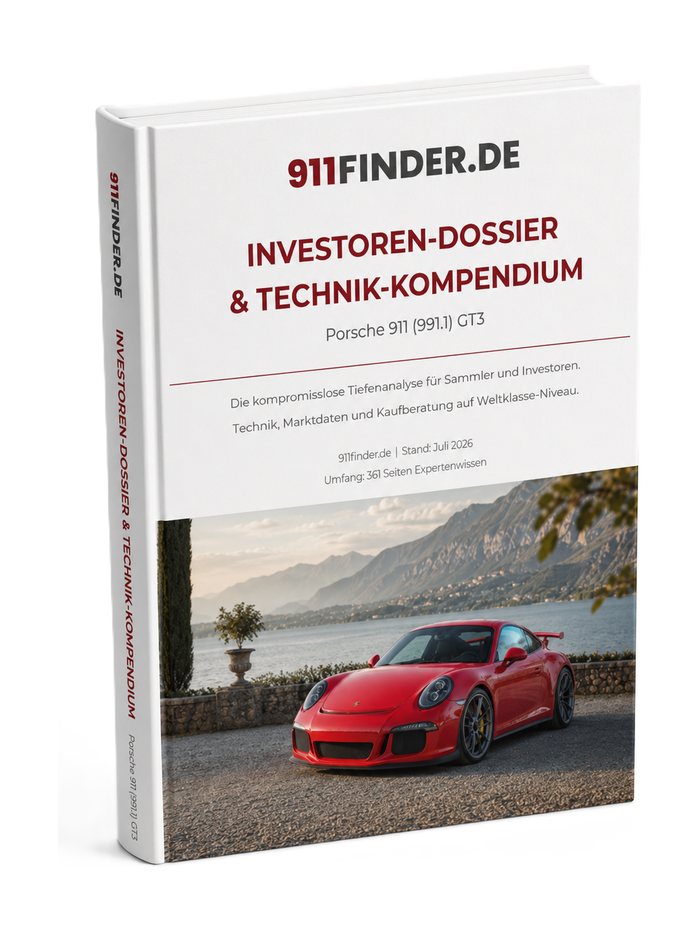
The complete knowledge: the Investor Dossier & Technical Compendium, in German

387 pages of specialist knowledge on the 991.1 GT3: how to identify the engine numbers (G6), detailed weak points, inspection checklists, production figures, the options that add value and price forecasts.

€97

incl. VAT

To the compendium (German)
Risk calculation

Running costs & risk calculation

The GT3 is a racing car. The costs are in proportion.

Typical work & faults

Work / faultApprox. costNote
Engine replacement (exchange engine)€25,000 - €30,000Without warranty (worst case)
PDK gearbox replacement5,000 - 15,000+ €If it fails
PCCB brake discs (per axle)5,000+ €Parts only (ceramic)
High-pressure fuel pump (HPFP)€1,500 - €3,000Replacement
Front axle lift repair€1,500 - €3,000Often the compressor or the lines
Front spoiler lip€200 - €400Wear item
Major service€1,500 - €2,500Every 20,000 km / 2 years
Market prices & investment, as at May 2025

Market prices & investment

The market is split in two: cars with and without the engine update.

CategoryPrice range
Original engine (E/F) / high mileage€110,000 - €120,000
With a G6 replacement engine€125,000 - €150,000
Clubsport / top history€140,000+

The deciding factor: a G engine demonstrably fitted raises the value and justifies a premium of €10,000 to €15,000, because the risk is eliminated.

The strategic conclusion from 911Finder

A fascinating GT3 that thrills you emotionally (9,000 rpm). But the engine history decides everything. An investment warning: Do not, under any circumstances, buy a 991.1 GT3 without checking the engine number and the warranty status. A car with an expired warranty and an old F engine is an incalculable risk.

The next step

Buy this 911 with confidence, with 911Finder.

Do you already own a Porsche 991.1 GT3? The Vehicle Documentation & Market Valuation puts the history, the paperwork and the market value of your car in order (€249 incl. VAT). Still looking? Then the right route is the Sourcing Enquire and name the model: Request a Digital Audit for a Porsche 991.1 GT3.