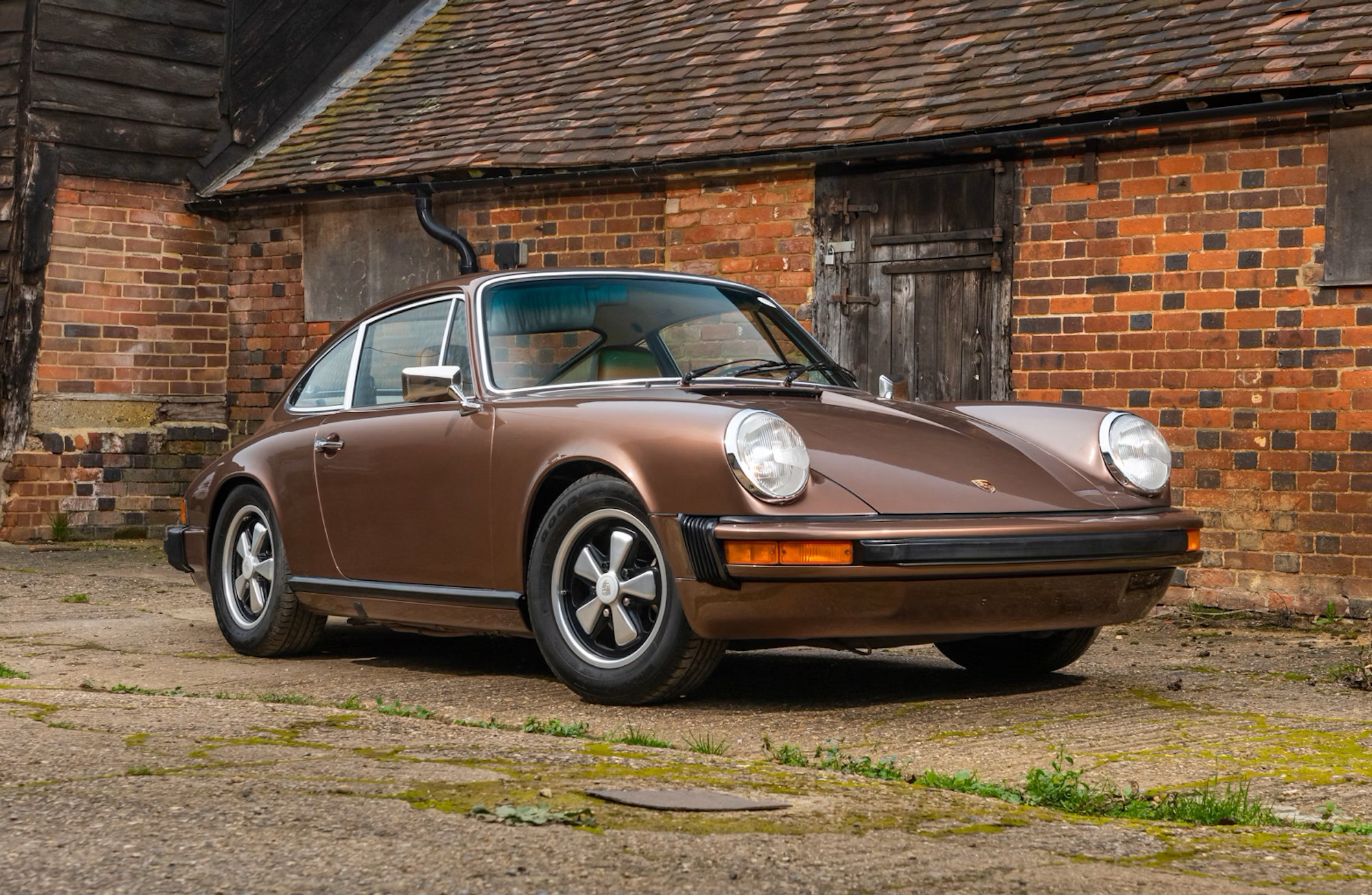
911 base 2.7
150 PS / 165 PS · the way in
- A 2.7L magnesium engine with K-Jetronic
- Solid performance: 0-100 km/h in 8.5 s
- The narrow body (the narrow-body G-Series)
- Often four speeds; five was an option
Home/Buyer's Guides/G-Series 1973-1977
The era of change · 1973-1977The early years: from the thermally vulnerable 2.7-litre magnesium engine to the robust Carrera 3.0. This buyer's guide helps you understand the technical risks and find the hidden jewels of this period.
The early G-Series cars (1973-1977) mark the transition from the delicate long-hood 911 to a more robust modern era. Shaped by US safety regulations, they brought the characteristic impact bumpers with concertina bellows.
Technically, this era is a minefield and a goldmine at once: from the thermally vulnerable 2.7-litre magnesium engine to the robust 3.0-litre aluminium case of the Carrera 3.0. Corrosion protection took a leap forward too, with full galvanising (from 1976) . This buyer's guide helps you understand the technical risks (the head studs) and find the hidden jewels of this period.
From the base 2.7 to the Carrera MFI
0 to 100 km/h (base 2.7)
Full galvanising begins
Four- or five-speed gearbox
From the base car to the legendary Carrera 2.7 MFI.
150 PS / 165 PS · the way in
175 PS · the happy medium
210 PS · the RS engine
From 1976 · 200 PS · the smart buy
Click the sections to read the full information.
The engines are the most critical point of this era. There are two constructions:
The 2.7-litre engines (magnesium): Used in the 911, the 911 S and the Carrera 2.7 MFI. The magnesium case is light, but thermally problematic.
The 3.0-litre engine (aluminium, Carrera 3.0): Derived from the Turbo (930), it uses a robust aluminium case.
The G-Series introduced the impact bumpers (an aluminium section with concertina bellows). US cars have hydraulic dampers, RoW cars (rest of world) have impact absorbers.
The evolution of corrosion protection:
Critical areas: Sills, jacking points, the B-pillar (the striker panel), the headlight bowls, the inner wing closing panels, the front battery box, the window frames.
The standard fitment was the type 915 gearbox (four or five speeds). More robust than its predecessor (the 901), but with quirks.
Suspension: Torsion bars. The rubber bushes age and make the car feel vague. Replacing them (with polyurethane if you wish) brings the precision back. Check the dampers (Bilstein/Koni).
Brakes: Solid disc brakes all round. The callipers can seize. Carrera cars often have aluminium callipers (S callipers), which cost more to overhaul.
Interior: Seats with integrated head restraints (a safety feature). The materials (cloth, vinyl, leather) age. Dashboards often crack (sunlight). Check the carpets for damp.
Electrics: Manageable, but corrosion on contacts and fuses is common. Wiring looms can become brittle. Check every convenience (windows, sunroof, ventilation).
Concentrated expert knowledge on the early G-Series cars: detailed weak points, inspection checklists, marks of originality, value-enhancing options and price forecasts.
Budget for these potential outlays.
| Work / component | Scope | Estimated cost |
|---|---|---|
| Head stud repair | Engine removal and case machining included | €8,000 - €20,000+ |
| Resealing (oil leaks) | Seals, tubes | €500 - €3,000 |
| MFI pump (Carrera 2.7) | Overhaul | €3,000 - €7,000 |
| Work / component | Scope | Estimated cost |
|---|---|---|
| Gearbox overhaul (915) | Synchromesh rings/bearings | €2,000 - €5,000 |
| Suspension bushes | Parts + fitting | €1,000 - €2,500 |
| Body (corrosion) | Sills/wings | €2,000 - €10,000+ |
| Dashboard | Repair/new | €300 - €1,500 |
Prices vary greatly by condition and model.
| Model | Good condition | Top condition |
|---|---|---|
| 911 base (2.7) | €55,000 - €80,000 | €80,000 - €100,000 |
| 911 S (2.7) | €60,000 - €90,000 | €90,000 - €120,000 |
| Carrera 3.0 | €75,000 - €110,000 | €110,000 - €150,000 |
| Carrera 2.7 MFI | €120,000 - €180,000 | €180,000 - €250,000+ |
The sweet spot: The Carrera 3.0 (from 1976). It offers the robust aluminium engine and the galvanised body at a fair price.
Take care: On 2.7-litre cars, documentation of the engine rebuild (the head studs) is essential. Without evidence, you are buying a €15,000 risk.
The listing, the paperwork and the price checked against real market data before you travel to view the car. A PDF dossier, usually within 24 h.
€199 incl. VAT · fixed price Assessment Level 2 · remoteDigital Audit plus follow-up questions, dealer answers, paperwork and a negotiating strategy, through to a clear buying decision.
€499 incl. VAT · audit included Assessment Level 3 · on siteA physical assessment where the car is: paint measurement, diagnostic readout, technical check, test drive and a negotiation brief.
from €790 incl. VAT · plus travelDo you already own a 911 from this model series? The Vehicle Documentation & Market Valuation puts the history, the paperwork and the market value of your car in order (€249 incl. VAT). Still looking? Then the right route is the Sourcing Enquire and name the model: Request a Digital Audit for a car from this model series.