On paper, the 911 Turbo is the safe bet of the 911 universe. In reality, though, the market is not a homogeneous block but a bundle of micro-markets: Coupé vs convertible, Turbo vs Turbo S, 997 vs 991 vs 992, and, depending on the phase, entirely different buyer behaviour.
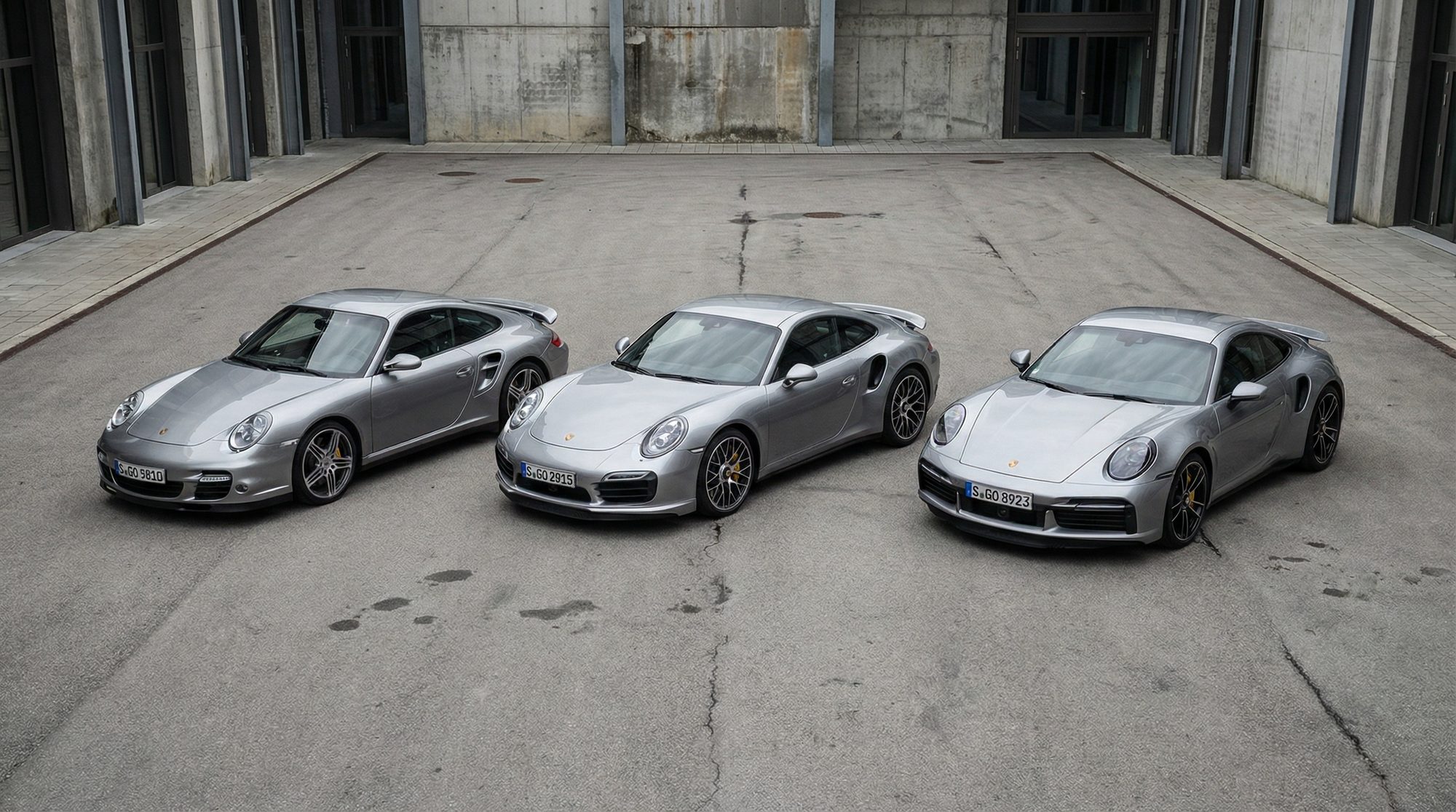
Cover image: the Turbo market looks stable, but the truth lies in the completed sale, not in the advertisement.
The guiding idea of this report: Asking prices are volume. Sale prices are truth. That is why we look consistently at the difference between the visible offer and realised sales.
The short conclusion in five points
Advertisements show expectations, realised sales show the real market band.
The 997 and 991 look more consolidated, the 992 remains more strongly driven by asking prices, but the prices sellers hope for are still rarely paid.
Forecasts only work variant by variant (Coupé/convertible, Turbo/Turbo S, transmission, market phase).
The spread of asking prices is wide, the market of completed sales is considerably more disciplined.
Mileage has a stronger effect on the 997 than on the 991. In younger segments, what wins is condition and configuration.
3
Generations: 997, 991, 992
Q4/25
A snapshot of the data
EU
MarqueScope SOLD archive, EUR entries only
5.-95.
percentile, excluding extreme outliers
Where does your Turbo sit in the market band? We place the car you are looking at using data: a realistic price range, a specification check and a market comparison.
Note: the figures represent market ranges, not guaranteed prices.
When advertisements show expectations and sales show reality
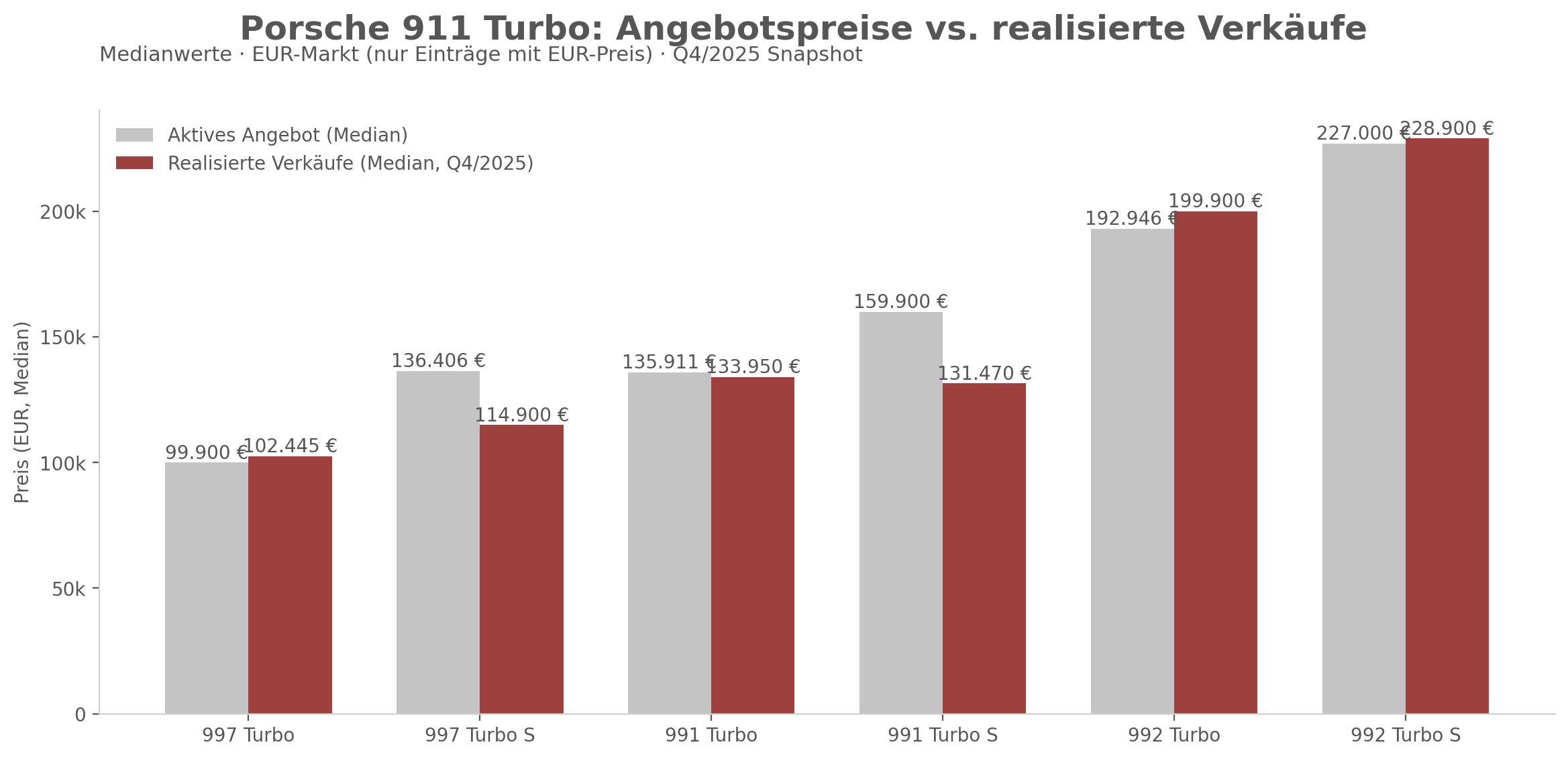
Asking prices vs realised sales
Chart 1: Median values, active vs sold. The market of completed sales is usually narrower and more honest than the visible offer.
On the 997 and 991 in particular you can see asking prices and market prices converging. The market is more mature, and buyers compare harder. On the 992 the supply side remains more dominant, though the same applies here: extreme advertisements are visible, but are realised far more rarely.
How accurate were the expectations?
Forecast vs reality
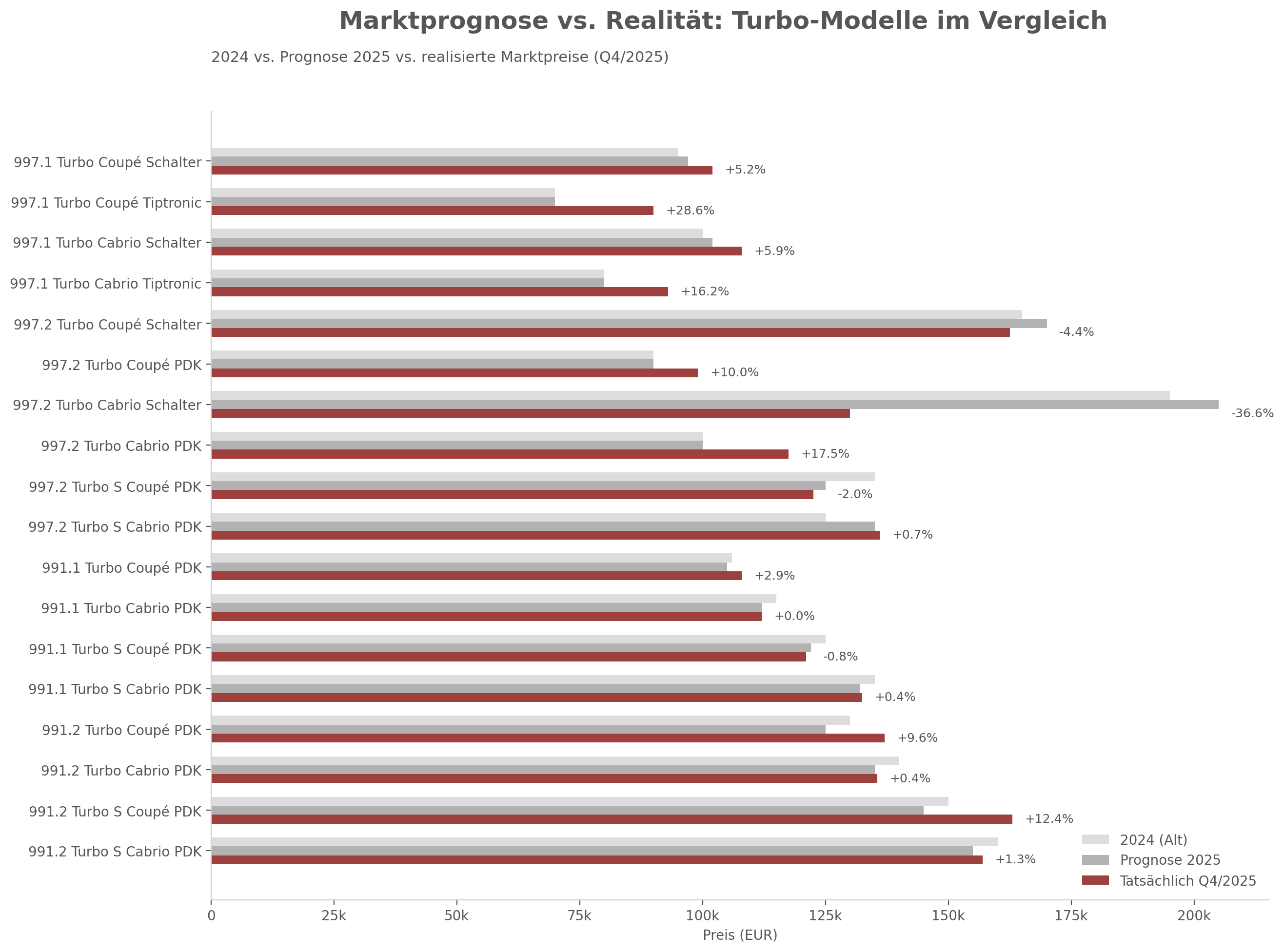
How accurate were the expectations, and where did the market get it wrong?
Chart 2: 2024 (old) vs the 2025 forecast vs the actual Q4/2025 figures. Deviations usually depend on the variant and the market phase.
A Turbo forecast only works if it does not forecast "the Turbo" but the specific variant.
This is exactly where the typical misvaluations happen: people take "997 Turbo" as a category, but the market values Coupé and convertible, transmission, condition and expectation completely differently. Individual deviations are therefore not "wrong" but an indication of the particularities of a segment.
The 911 Turbo model bible
The complete knowledge: the Investor Dossier & Technical Compendium, in German
Expert knowledge on the Turbo you are looking for: detailed market data, weak points, inspection checklists, production figures, value-enhancing options and price forecasts.
Why the visible range is wider than the real market
Chart 3: 5th to 95th percentile (excluding extreme outliers). Active is wider, sold is the disciplined core.
This is precisely why market prices cannot be derived from the top listings. The core market (realised sales) is narrower, and when it moves, it usually moves first in the areas where cars are most easily replaced.
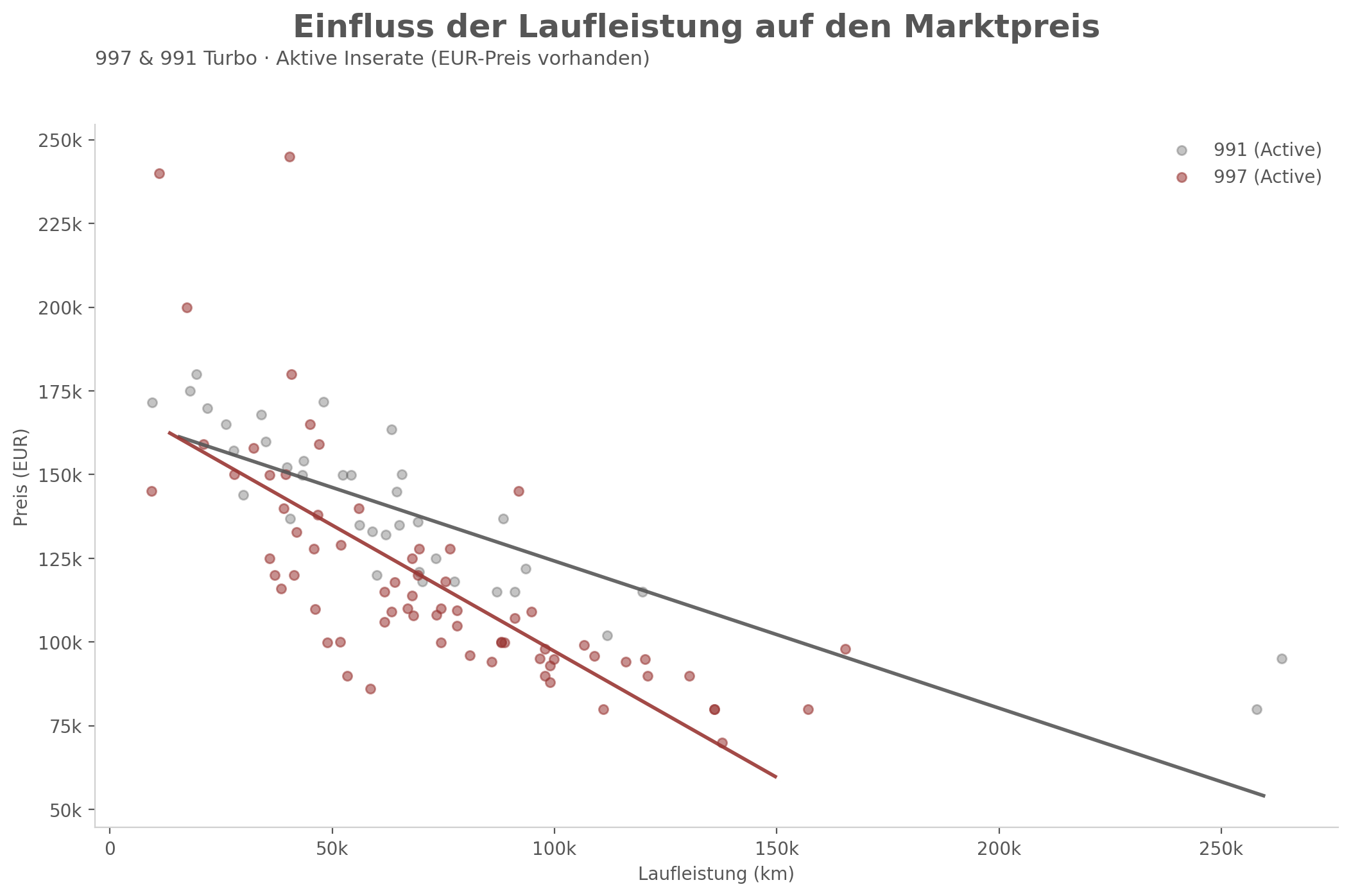
Mileage as a price factor
Why the kilometres count for more on the 997 than on the 991.
Chart 4: Mileage vs price (997 and 991, active). The trend lines show the relationship without giving too much weight to outliers.
In the 997 segment the mileage effect is clearer: buyers judge use more strictly, above all where collector and classic logic applies. On the 991, mileage is cushioned more by condition, specification and overall impression. In newer segments, the specification often matters more than the mileage alone.
Stabilising value rather than driving it
Specification: what really counts
An important point
In the Turbo market, specification usually stabilises valuerather than driving it. Many options are expected by the market but not paid for in full. What matters is what counts as a must-have in the segment in question.
Typically stabilising
Sport Chrono (depending on the generation)
PCCB (depending on the case, more so on top-specification cars)
A clean history / traceable servicing
A good colour combination and a coherent interior
Often overrated
An "expensive options list" without a clear story
Individualisation that is too specific
Cosmetic options without a technical foundation
Price premiums based only on the seller's own opinion
What you should take away from this report
Buyer logic, seller logic, market logic.
For buyers
Use advertisements as a shortlist, not as proof of the market.
What matters more is realised sales, clean comparability and the question: how easily replaced is this car, really?
For sellers
Time on the market is a signal. When the market of completed sales narrows, the price positioning has to do more than say "lots of options".
A car priced to the logic of the market sells faster.
Methodology and transparency
Data: the MarqueScope SOLD archive (EU), EUR entries only. The aim: realistic market ranges, not guaranteed prices. The report is a snapshot of Q4/2025.
Context image: 911Finder, market analysis where prices are made, in the comparison and in the completed sale.
911Finder Market Intelligence: independent market analysis for Porsche 911 cars. As at Q4/2025.